Originally reported on November 11, 2026, at 10:29 a.m. UTC+8.
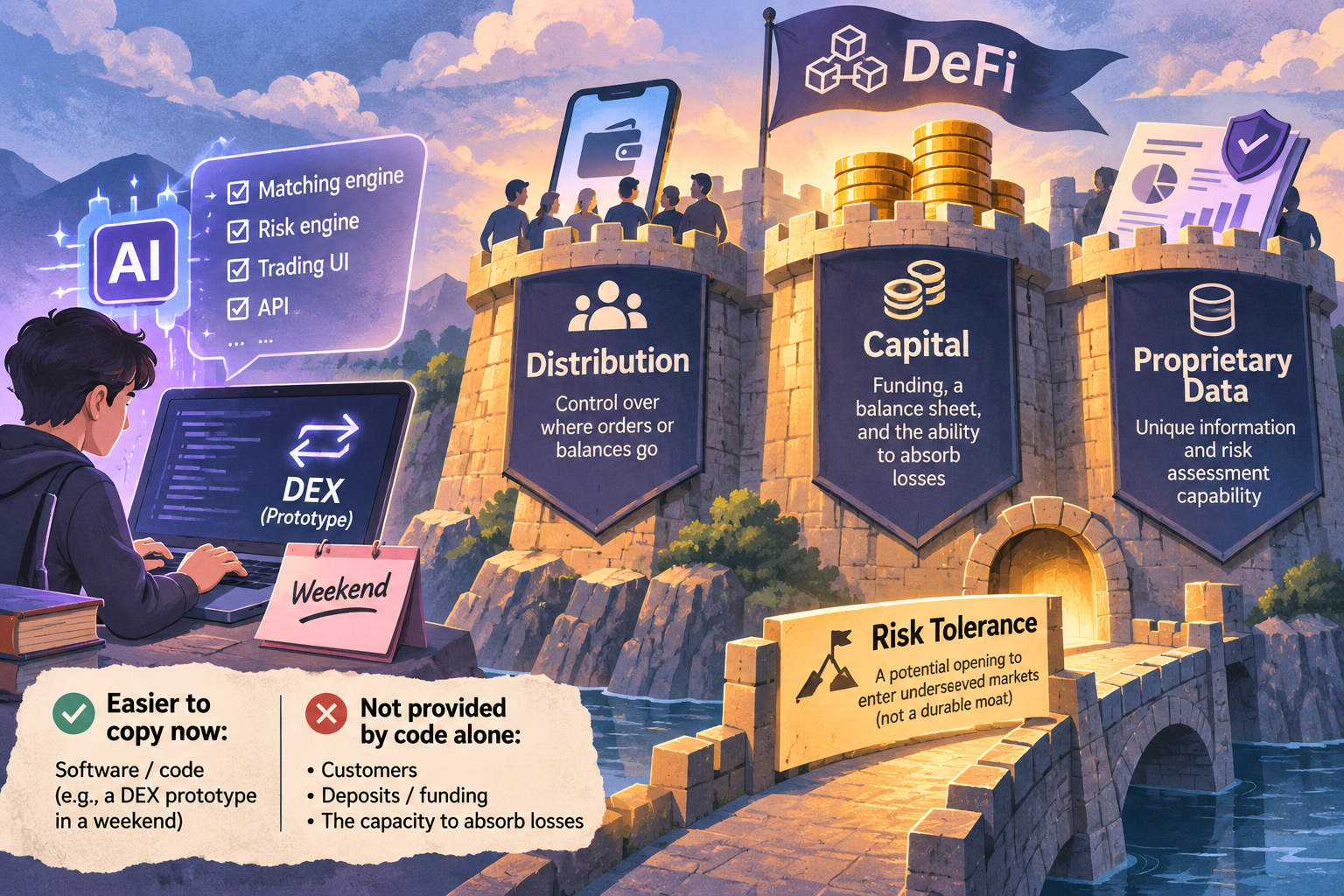
AI tools are making financial software cheaper to build, but Multicoin Capital investment partner Spencer Applebaum argues that code is becoming a smaller part of a DeFi business’s competitive advantage. In his account, an AI-assisted founder could now build much of a decentralized exchange prototype over a weekend. That would not, by itself, bring in customers, deposits or the capacity to absorb losses.
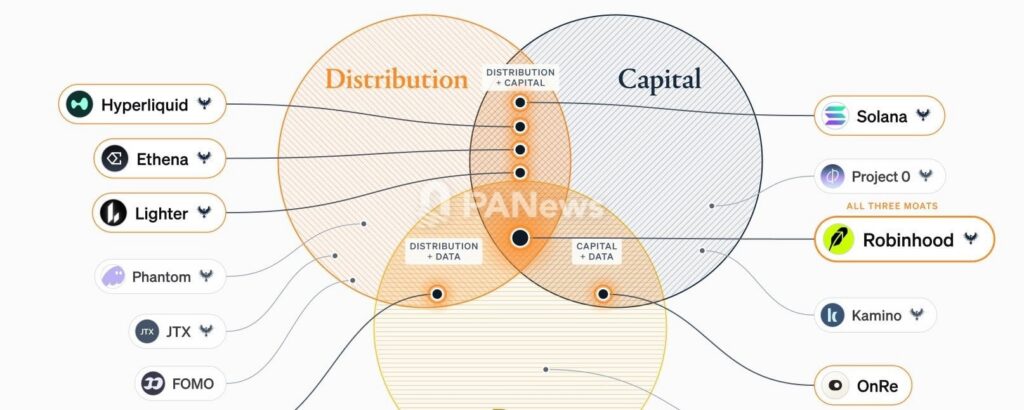
Applebaum’s framework identifies three harder-to-copy resources: distribution, capital and proprietary data. He describes willingness to take risks that established firms avoid as a potential opening for startups—not a durable moat on its own.
Distribution: who controls the customer relationship?
Applebaum defines distribution as control over where orders or balances go. He points to wallets that charge for access to trading, even when another platform executes the trade. His examples include MetaMask’s 0.875% trading fee, compared with Uniswap’s average fee rate of 0.13% over the preceding 12 months. The comparison has a limit: much of Uniswap’s trading fees goes to liquidity providers rather than the protocol.
He also cites Hyperliquid’s arrangement with Coinbase under its Aligned Quote Asset framework. According to the article, roughly 90% of the reserve yield associated with USDC on Hyperliquid goes to the protocol’s Assistance Fund to buy HYPE. Applebaum’s point is that the platform’s ability to attract balances gives it negotiating power, even though it does not run the underlying stablecoin infrastructure. He cautions that a frontend’s position may be less secure when users can readily switch interfaces.
Capital and data: what code cannot supply
Trading and lending systems need funding, while some participants must bear losses when positions go wrong. Applebaum argues that a DeFi prime broker would need a substantial balance sheet, low-cost funding and risk-management capability—not just software that coordinates collateral across venues. He distinguishes capital owned by a protocol from deposits that users may withdraw when better opportunities appear.
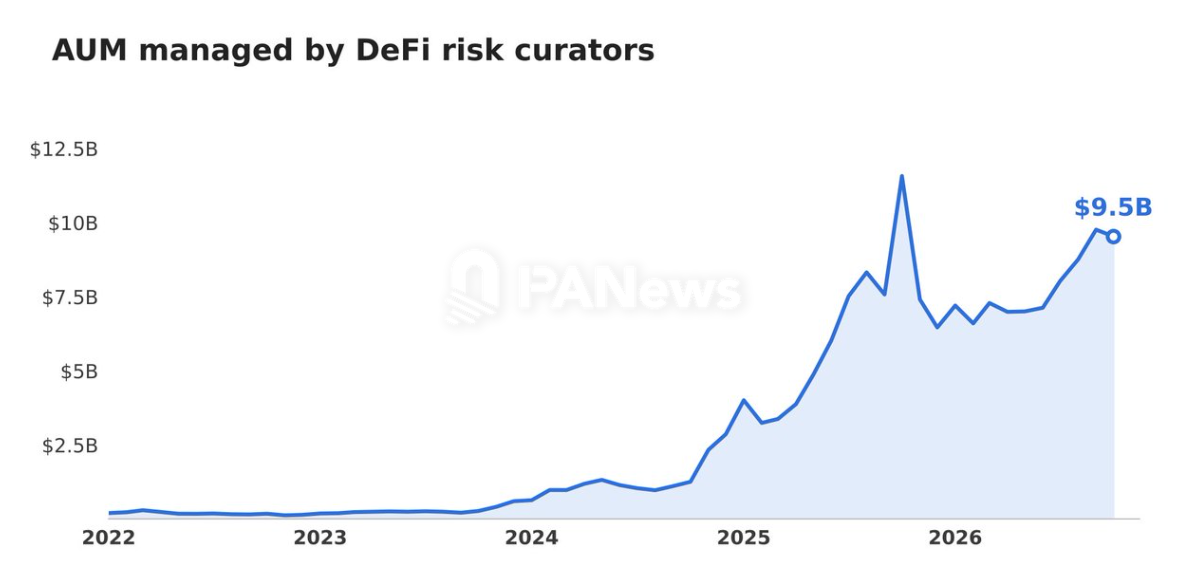
For proprietary data, he contrasts lending vault curators working largely with public crypto-market information against OnRe, which underwrites real-world reinsurance risk using information unavailable on a block explorer. The businesses carry different risks, a qualification he acknowledges when comparing their fees.
An opportunity, not a guaranteed cycle outcome
Applebaum expects AI to lower the cost of entering markets that incumbents have not served. But his broader prediction—that trillions of dollars in financial activity will move on-chain over the next decade—is an investment thesis, not an established outcome. His central distinction is narrower: competitors may be able to reproduce software quickly, while customer relationships, loss-bearing capital and specialized data take longer to build.
Source: panewslab.com (originally published 2026-11-11 10:29 UTC+8)