
As reported on November 17, 2026, the US Supreme Court had declined on Monday to hear Custodia Bank’s appeal over access to the Federal Reserve’s payment system. The decision ended the Wyoming-chartered, crypto-focused bank’s latest legal effort to obtain a Fed master account. It did not prevent Custodia from applying again.
A master account would let Custodia process payments directly rather than rely on other financial institutions. Founded by Caitlin Long, the bank has sought one since 2020. It sued the Federal Reserve in 2022 after waiting about two years for a decision, but the Federal Reserve Bank of Kansas City rejected its application in January 2023, citing risks associated with its crypto-focused business model.
A federal appeals court ruled against Custodia in October 2025, finding that Federal Reserve banks need not grant master accounts to every eligible institution. The court declined to reconsider that decision in March 2026. In a dissent, US Circuit Judge Timothy Tymkovich argued that the ruling gave the Fed power to override state banking decisions, writing that a bank cannot operate in the modern banking system without a master account.
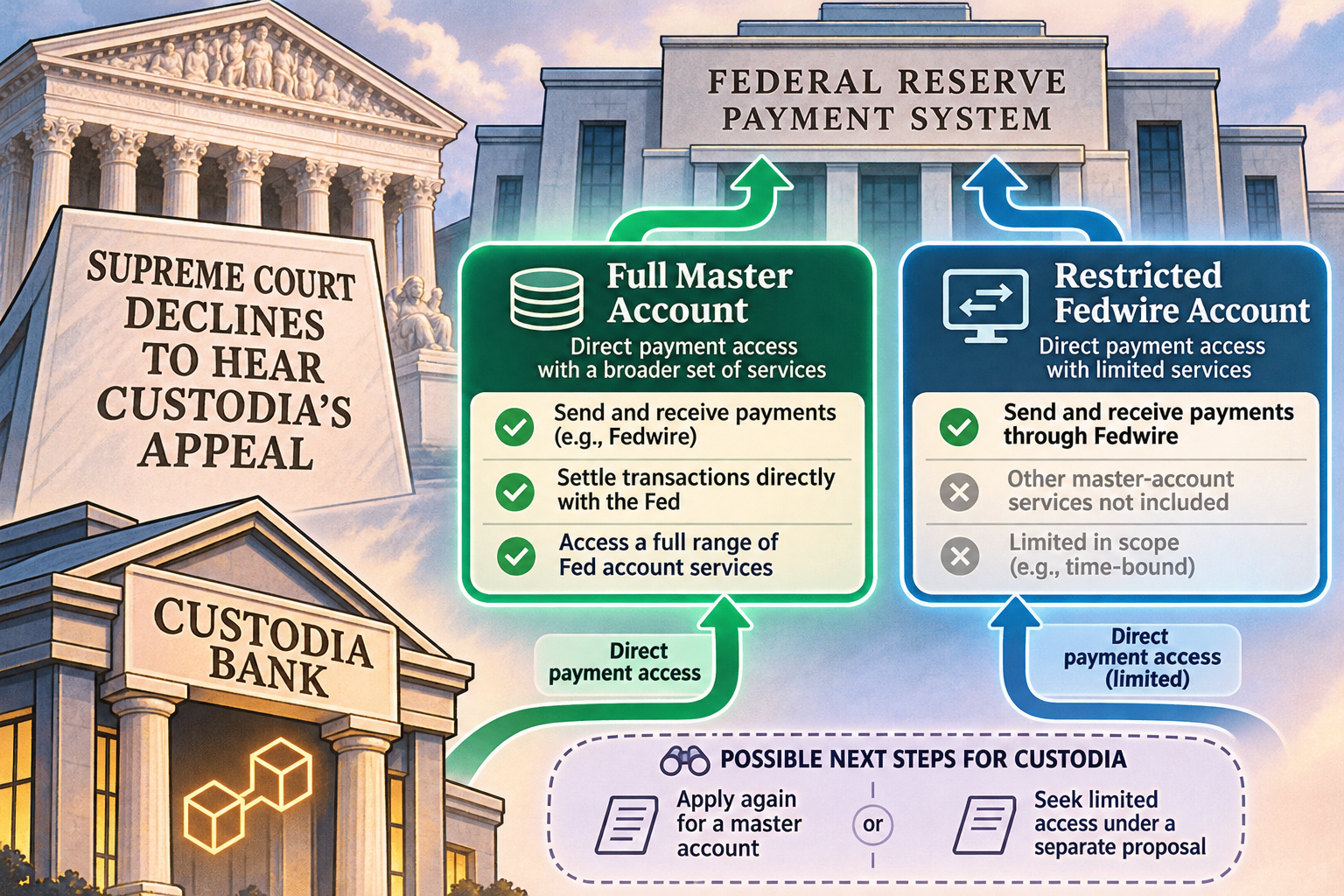
Custodia’s Supreme Court appeal drew support from the Blockchain Association, which argued that the Fed’s discretion could weaken state banking regulators’ authority. Senator Cynthia Lummis and former Senator Patrick Toomey also filed a supporting brief in August 2026.
The distinction between some Fed access and a full master account remains important. In March 2026, the Kansas City Fed approved Kraken Financial for an initially one-year, restricted account that permits payments through Fedwire but does not provide all master-account services. Custodia may still apply for another master account or seek limited access under a separate proposal. Neither path was granted by the Supreme Court’s decision.