
Reporting dated November 24, 2026 described a product opening, not a Bitcoin price move. On November 23, 2026, Cross River Bank launched its first Bitcoin-backed lending program as a loan originator. Eligible LendingUSA customers can borrow $10,000 to $250,000.
What borrowers can pledge
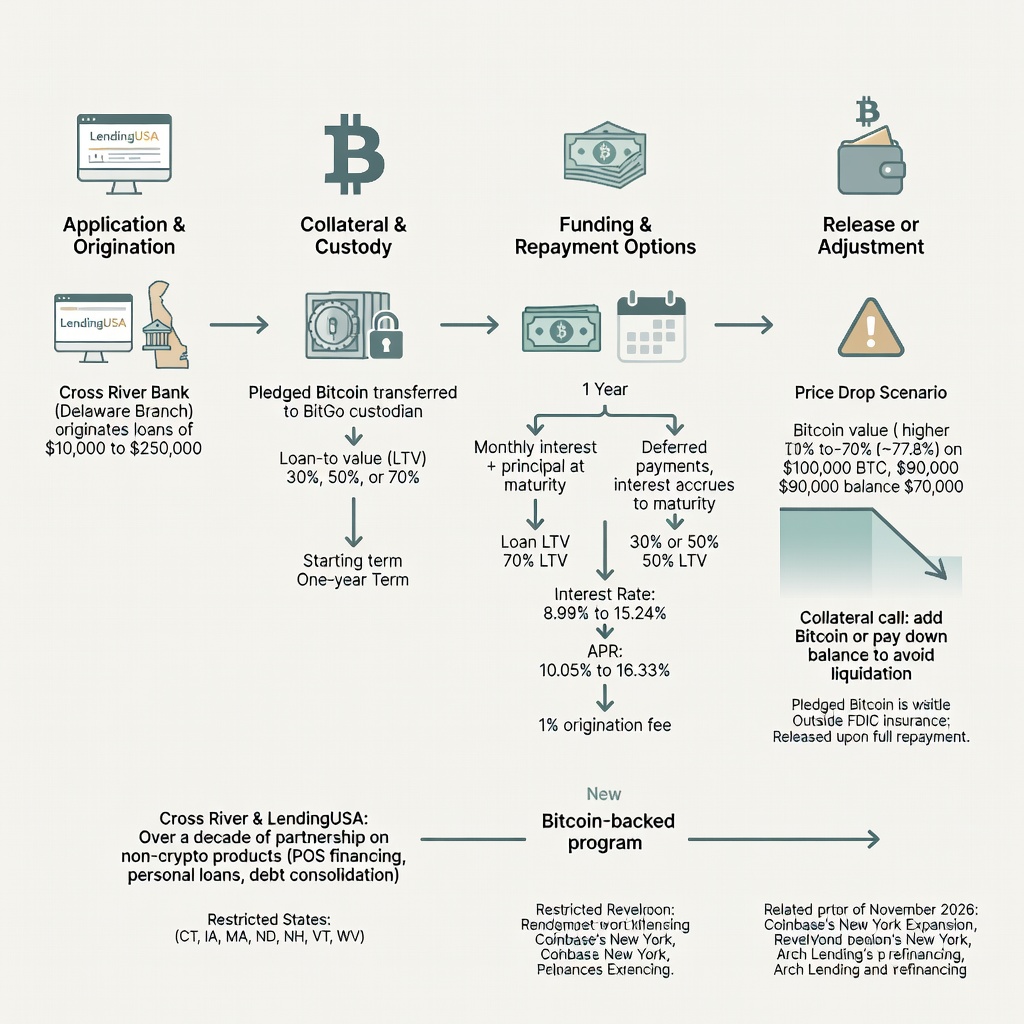
A joint announcement from Cross River and LendingUSA says borrowers can pledge Bitcoin for cash and choose how much of the collateral’s value to borrow. Starting loan-to-value ratios are 30%, 50%, or 70%. BitGo holds the pledged Bitcoin. LendingUSA lists a one-year term, and borrowers can repay early without a prepayment penalty.
Cross River makes the loans through its Delaware branch. LendingUSA handles the online application and guides borrowers through posting collateral. After approval, borrowers review the terms, transfer Bitcoin to the custodian, and sign the agreement. LendingUSA says it sends funds once the collateral is verified.
LendingUSA lists Connecticut, Iowa, Massachusetts, North Dakota, New Hampshire, Vermont, and West Virginia as restricted states for the product.
How size and price are set
Loan-to-value measures the loan against the Bitcoin pledged. At the three starting ratios, $100,000 of Bitcoin would support a loan of $30,000, $50,000, or $70,000, subject to approval. A borrower seeking the full $250,000 at the highest starting ratio would need to pledge about $357,143 in Bitcoin. At 50%, the same loan would require $500,000 in collateral.
LendingUSA’s product page lists interest rates of 8.99% to 15.24%, annual percentage rates of 10.05% to 16.33%, and a 1% origination fee. The companies say the rate depends on the starting loan-to-value, the repayment option, and whether the borrower enrolls in automatic payments. Cross River considers the value of the pledged Bitcoin, the applicant’s ability to repay, and credit history.
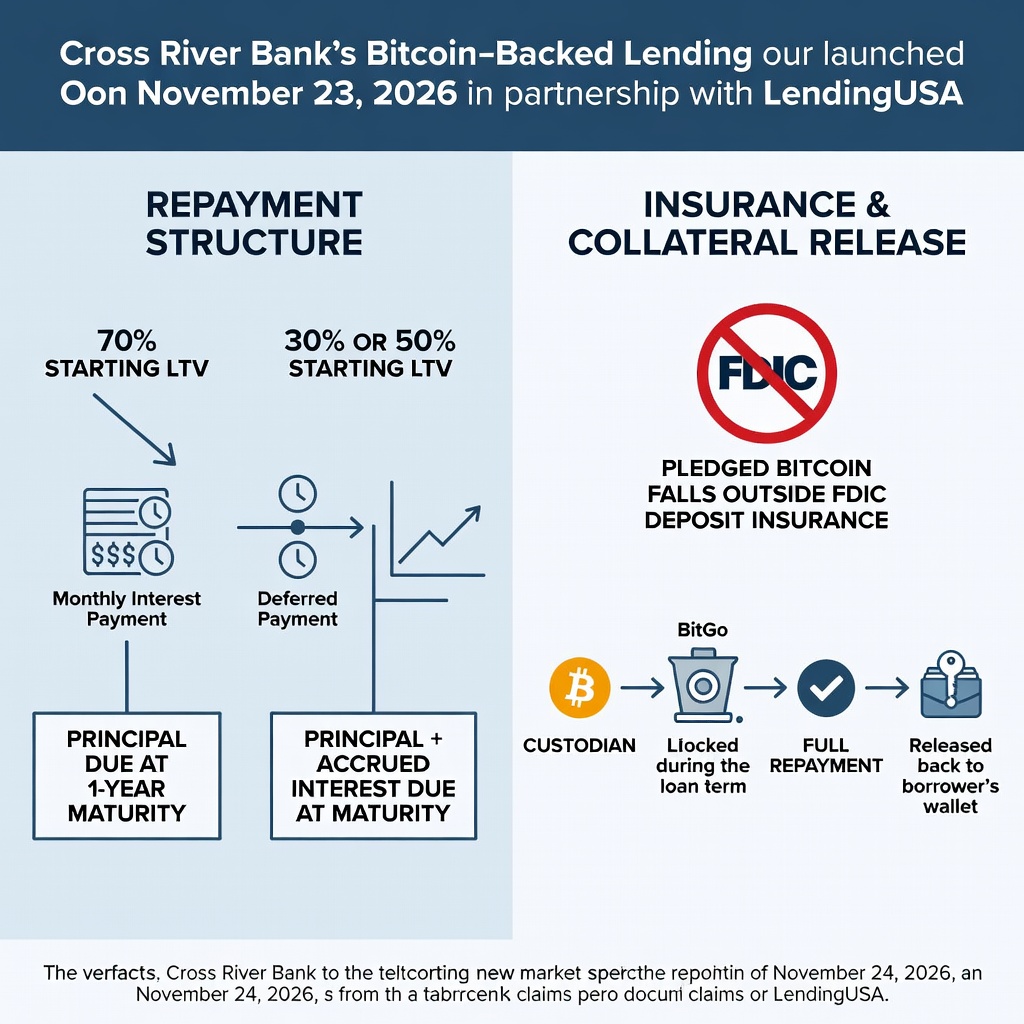
The repayment choice depends on how much is borrowed against the collateral. At 70% loan-to-value, borrowers must make monthly interest payments and repay the principal at maturity. At 30% or 50%, eligible customers can defer monthly payments. Interest accrues throughout the term on that plan, so both principal and accumulated interest are due at maturity.
When the price falls, the ratio rises
A drop in Bitcoin’s price pushes the loan-to-value higher even if the amount owed stays the same. That is arithmetic on the collateral. It is not an explanation of why the price moved, and the announcement does not report liquidations or flows.
Using LendingUSA’s formula, a $70,000 balance against $100,000 of Bitcoin starts at 70% loan-to-value. If the collateral falls to $90,000 and the balance stays level, the ratio rises to roughly 77.8%. LendingUSA says borrowers may then be asked to add Bitcoin or pay down part of the balance to avoid liquidation. Its public terms describe the process without giving a percentage that triggers a collateral call or sale.
If a sale falls short of covering the loan, the borrower still owes the balance. The pledged Bitcoin falls outside FDIC deposit insurance. LendingUSA says it attempts to notify borrowers before they need to act, though the speed of a price move can affect that notice. Once the loan is fully repaid, the company says the collateral is released back to the borrower’s wallet.
A long credit relationship, then a different role
Cross River and LendingUSA have worked together for more than a decade on point-of-sale financing, unsecured personal loans, and debt consolidation. Those earlier products were not Bitcoin-backed. The new loans add a custodian, a chosen starting ratio, and collateral calls those products did not use.
LendingUSA says it has served more than 200,000 borrowers since its founding in 2015 and has recorded more than $1.5 billion in loan originations. “People who invest in Bitcoin for the long term still have financial needs today,” LendingUSA CEO Camilo Concha said in the announcement. Cross River President Evan Russo pointed to the companies’ decade of working together as the basis for launching the product with LendingUSA.
The bank took a different role in a June agreement with Figure Technology Solutions. Cross River’s Principal Finance Group committed to buying up to $250 million in assets to support Figure’s crypto-backed lending. That was a purchase commitment, not this origination program.
In early November 2026, as crypto.news reported, Cross River and Offchain completed a proof of concept for loan tokenization on Arbitrum, with a production rollout targeted for early 2027. A completed test and a 2027 target are not a live tokenized-loan market.
Separate borrowing options the same month
Other November 2026 products expanded access to crypto-backed cash. They do not set Cross River’s rates, and they are not evidence of a shared cycle turn.
Coinbase opened crypto-backed borrowing to eligible New York customers in November 2026, completing the rollout of Coinbase Borrow across all 50 states. Customers in New York can borrow USDC against Bitcoin, Ethereum, or Solana through the Morpho-powered service. At the time of the expansion, Coinbase reported more than $3.4 billion in originations since January 2025 and more than $1.7 billion outstanding.
Arch Lending introduced a crypto loan refinancing program earlier in November 2026 and says it can cut qualifying borrowers’ existing rates by up to two percentage points. Arch pays the original lender directly so borrowers can transfer the collateral without first repaying the balance out of pocket. The original lender’s margin-call and liquidation rules apply until it releases the collateral.
The likeness is narrow: cash against crypto collateral. Cross River’s offer is distinct in its originator, the $10,000 to $250,000 range, the three starting ratios, BitGo custody, the one-year term, the state limits, and public terms that still do not name a collateral-call threshold.