Bitcoin fell below $58,000 on November 25, 2026, after a hot US inflation reading and fresh tariff threats. It recovered enough to close above $58,525, its June closing low. By November 26, it was trading at $60,609, up 2.2% on the day.
That distinction between an intraday low and a daily close matters to Galaxy. The firm argued in October that Bitcoin’s bear market had ended in June. Research head Alex Thorn withdrew that assessment during the week of November 26 after Bitcoin fell back below its 50-week moving average. Galaxy now watches for a daily close below $58,525 to mark a break of the June low. In all seven comparable breaks Galaxy identified in past bear markets, Bitcoin eventually traded at least 17% lower. The November 25 decline did not meet that test.
How this decline differs from past lows
As of November 22, Bitcoin had met only two of the 13 conditions Galaxy tracks at bear-market lows. One notable difference was the time spent below realized price, a measure of the average cost basis of all bitcoin. In every previous bear market Galaxy examined, Bitcoin spent at least 140 days below that measure. In this one, it had yet to record a single daily close below it.
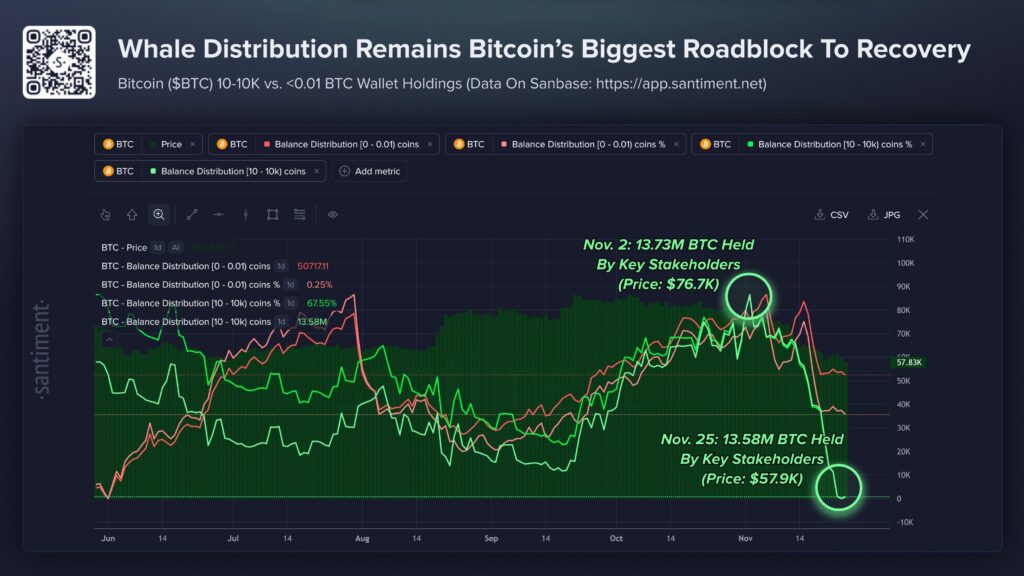
Santiment’s holdings data also gave little indication that large holders had stopped selling. The groups it calls sharks and whales had reduced their combined holdings by about 150,000 BTC since November 2, though they still held 67.55% of supply. Santiment said a more durable relief rally would require those balances to stabilize and start rising again.
Sentiment was less clear. Santiment counted about 70 positive comments for every 100 negative ones, a degree of pessimism that has often preceded recoveries. But some traders saw the fear itself as a reason to buy. Santiment said a bottom would look more convincing if even habitual dip buyers began to doubt that strategy.
The levels beyond June’s low
Gold and silver also fell on November 25 after the inflation release. Analyst Benjamin Cowen argued that Bitcoin typically bottoms after both metals. Further Bitcoin losses remained his base case if the metals continued to fall.
Below the June closing low, Glassnode’s cost-basis data pointed to support at $56,800, with another cluster near $46,700. On the upside, Bitcoin faced resistance near $63,100. For Galaxy, a weekly close above the 200-week moving average, near $68,000, would be a first step toward reconsidering its bottom call, not confirmation that the bear market had ended.