
Ethereum developers have scheduled the Glamsterdam upgrade for the Hoodi testnet on December 15, 2026, at 19:12:24 UTC. The configuration will introduce new gas prices for certain operations and raise Hoodi’s block gas limit to 200 million at the same time. As of November 29, Ethereum had not set a mainnet date.
The main compatibility risk is in contracts that allocate a fixed amount of gas to part of a transaction. Those budgets accounted for 182 of 200 findings in a review of deployed code. On November 28, Ethereum co-founder Vitalik Buterin backed the repricing proposed in EIP-8037 but urged developers not to rush Glamsterdam. He said core developers should help applications whose designers had reasonably treated the old gas rules as fixed.
What the new gas prices would cover
EIP-8037 would charge 1,530 gas for each byte added to Ethereum’s state: the balances, contract code and storage that full nodes keep. Under existing rules, the cost of adding the same amount of data depends on how it is created. EIP-8038 would adjust the cost of accessing and updating existing data.
| Operation | Existing gas cost | Proposed change |
|---|---|---|
| Create a storage slot | 20,000 | Rises to 97,920 |
| Create an account | 25,000 | Rises to 183,600 |
| Deploy a full 24 kB contract | About 4.9 million | Rises to about 37.8 million |
| Update an existing storage slot | — | Adds about 7,200 per write |
| First access to an account in a transaction | 2,600 | Rises to 3,000 |
| First read of a storage slot | 2,100 | Unchanged |
The proposal’s authors point to what happened when the block gas limit rose from 30 million to 60 million: the amount of new state added each day roughly tripled. Geth’s state database stood at about 390 GiB in January 2026. At a 200 million gas limit and existing prices, the authors project roughly 387 GiB of new state per year, enough to cross a 650 GiB performance threshold in under a year. Their target is 120 GiB of annual growth.

Why a higher wallet limit may not help
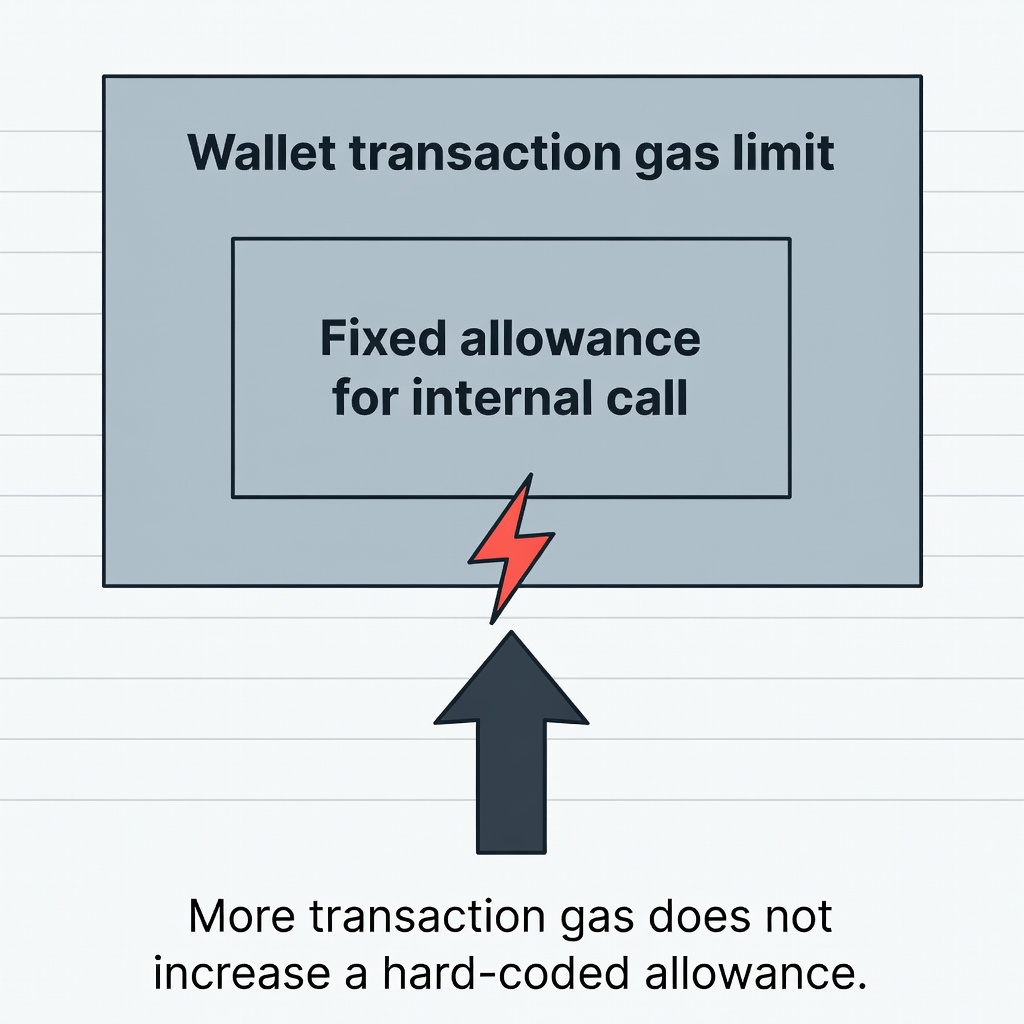
A wallet’s gas limit applies to the whole transaction. A contract can impose a separate, smaller limit on an internal call, such as one step in a withdrawal. If that step becomes more expensive than its allowance, the call reverts even if the transaction has gas to spare. Raising the limit at signing does not change the allowance written into the contract.
Fixed allowances are one of eight assumptions flagged in Ethereum Foundation guidance. For example, contracts that calculate charges by comparing two gasleft() readings could get the wrong result because remaining gas can rise during a call under the new rules. Gas reserved for a later storage write may also fall short. The EIP-8037 authors identified ERC-4337 bundlers, which process batches of smart-wallet transactions, as one group that could assign costs incorrectly.
The Foundation commissioned ChainSecurity and Dedaub to investigate and also conducted its own reviews. ChainSecurity’s November 18 assessment combined AI-assisted code review with a year of mainnet transaction traces. It replayed flagged cases under both sets of rules. Including the Foundation’s work, the assessment recorded three high-, 30 medium- and 167 low-severity findings, with none rated critical.
These are findings, not 200 distinct applications. The public summary named no individual systems. It covered bridges, messaging systems, wallets, exchanges, governance, oracles, staking protocols and supporting off-chain services. ChainSecurity cautioned that a system’s absence from the results does not establish that it is unaffected.
Most findings can be resolved without new code, according to ChainSecurity. An operator can raise a configurable allowance without requiring users to act. But 24 findings require an upgrade or migration. An upgrade can replace the logic at the existing address, subject to governance approval where required. If the contract cannot be changed, positions remain in it until users move them to a replacement following the team’s instructions.
What a successful Hoodi fork would establish
Developers postponed Hoodi’s original October 26 fork to investigate compatibility. On November 6, the Foundation said the fork would wait until the issues were resolved. By November 9 it had received four reports of live contracts that could break. It scheduled a November 16 call for auditors to present findings and a November 19 discussion of next steps. Developers retained the specification and merged the December 15 testnet configuration.
If Hoodi continues finalizing blocks after the fork, that will show that client software agrees on the new rules at the higher block gas limit. It will not show that a particular bridge can complete a withdrawal or that a staking contract can pay out. For that, application teams need to replay their own transactions on Hoodi and report the results.
The testnet holds no real funds, and its fork requires no action from mainnet users. Ahead of any mainnet activation, EIP-8038 also calls for wallets using standard gas estimation to adopt the revised formulas. Otherwise, they could underestimate gas and submit transactions that fail. Once wallets and node providers update, the usual signing process can stay the same.