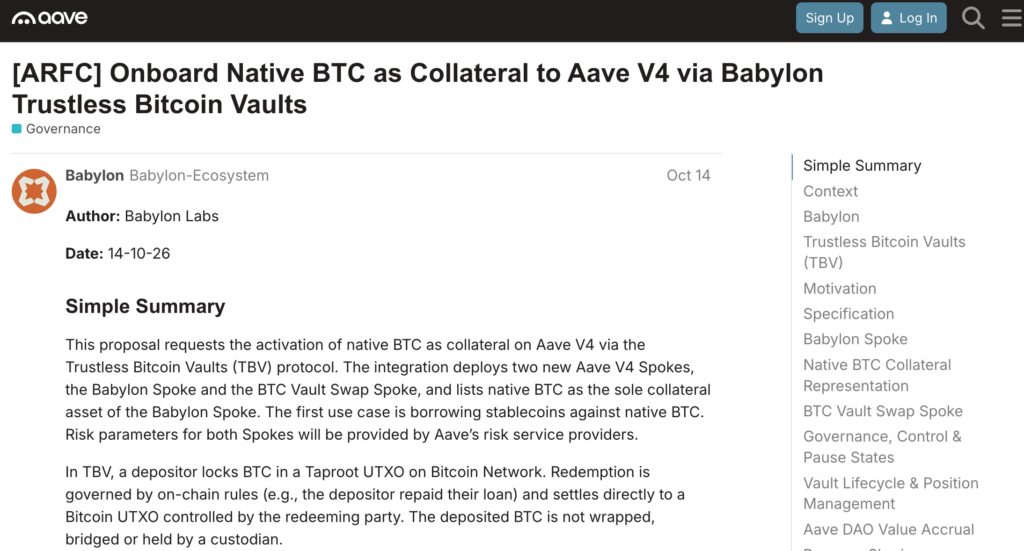
As reported on November 10, 2026, Aave DAO had backed a proposal to let holders use native Bitcoin as collateral on Aave V4 through Babylon’s trustless Bitcoin vaults. Babylon said the November 9 ARFC vote passed with 100% support. That was not a mainnet launch: the proposal still needed an AIP, Aave’s final on-chain execution vote, and targeted a phased rollout by the end of 2026.
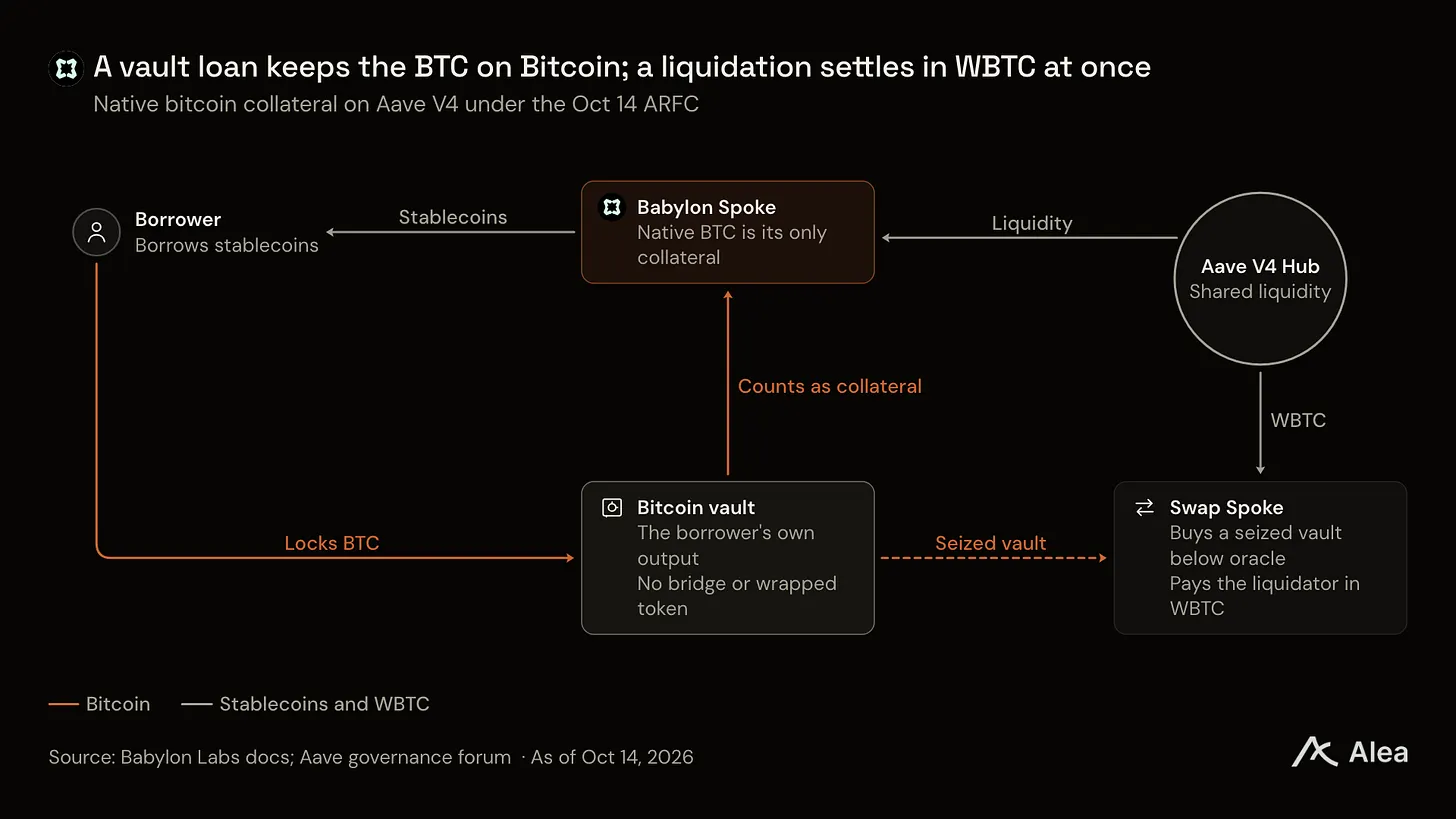
Under the proposed design, borrowers would lock BTC in a Taproot vault on the Bitcoin network while retaining control of their private keys. A non-transferable accounting token on Ethereum would represent the locked BTC for use as Aave V4 collateral, enabling borrowing in assets such as USDT and USDC. The plan does not require borrowers to wrap their BTC or hand it to a third-party custodian.
The proposal was first submitted in May and passed a June community temperature check with 299,743 AAVE votes in favor and none against. Aave founder Stani Kulechov expressed support in the governance forum when the formal proposal was published on October 14.
Terms, capacity and the remaining dependency
LlamaRisk’s proposed parameters set the native BTC collateral ratio at 78% and the maximum liquidation bonus at 5.55%. PANews reported that the collateral ratio and borrowing rate were comparable to those for WBTC and cbBTC in Aave V4’s core market. Alea Research relayed Babylon’s estimate of a 3%–5% annualized borrowing cost through the vaults, versus a 9%–16% range it cited for centralized lending platforms. Those figures are estimates and comparisons, not a guarantee of borrowing costs.
The proposed initial credit lines total about $21 million: $8 million each for USDT and USDC, $2 million each for USDG and RLUSD, and $1 million for GHO. Native BTC collateral would initially be capped at 300 BTC. Any later increase in the credit lines would require Aave DAO approval.
Keeping BTC on its own chain does not remove every dependency on wrapped assets. The proposed liquidation module would have liquidators buy seized vaults with WBTC, after which arbitrageurs could redeem the BTC on the Bitcoin network. In other words, the collateral arrangement avoids a Bitcoin custodian, but liquidations would still rely on WBTC.
How the proposed revenue split works
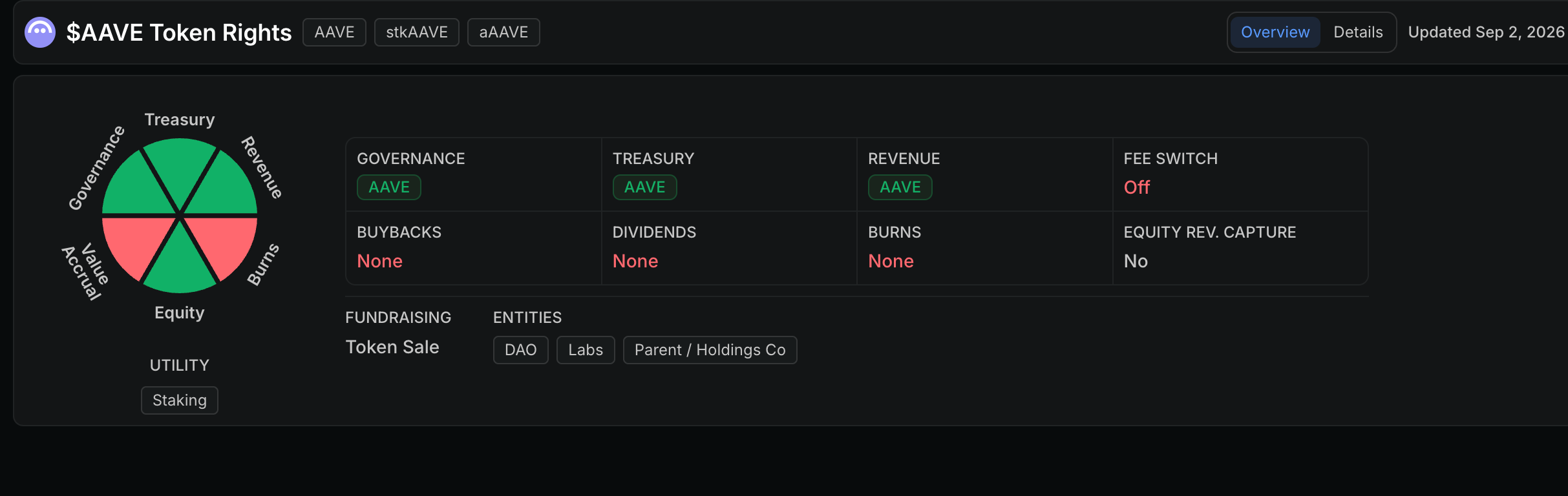
Only two fee streams would enter the proposed split: Aave’s liquidity fee from interest paid by borrowers on this line, and liquidation fees. Aave DAO would receive the first $500,000 of annual revenue. On the portion from $500,000 to $2 million, Aave DAO would receive 78%, Babylon 18%, and 4% would fund token buybacks. The shares change across further tiers; above $6 million, they would be 61.5%, 31.5% and 7%, respectively.
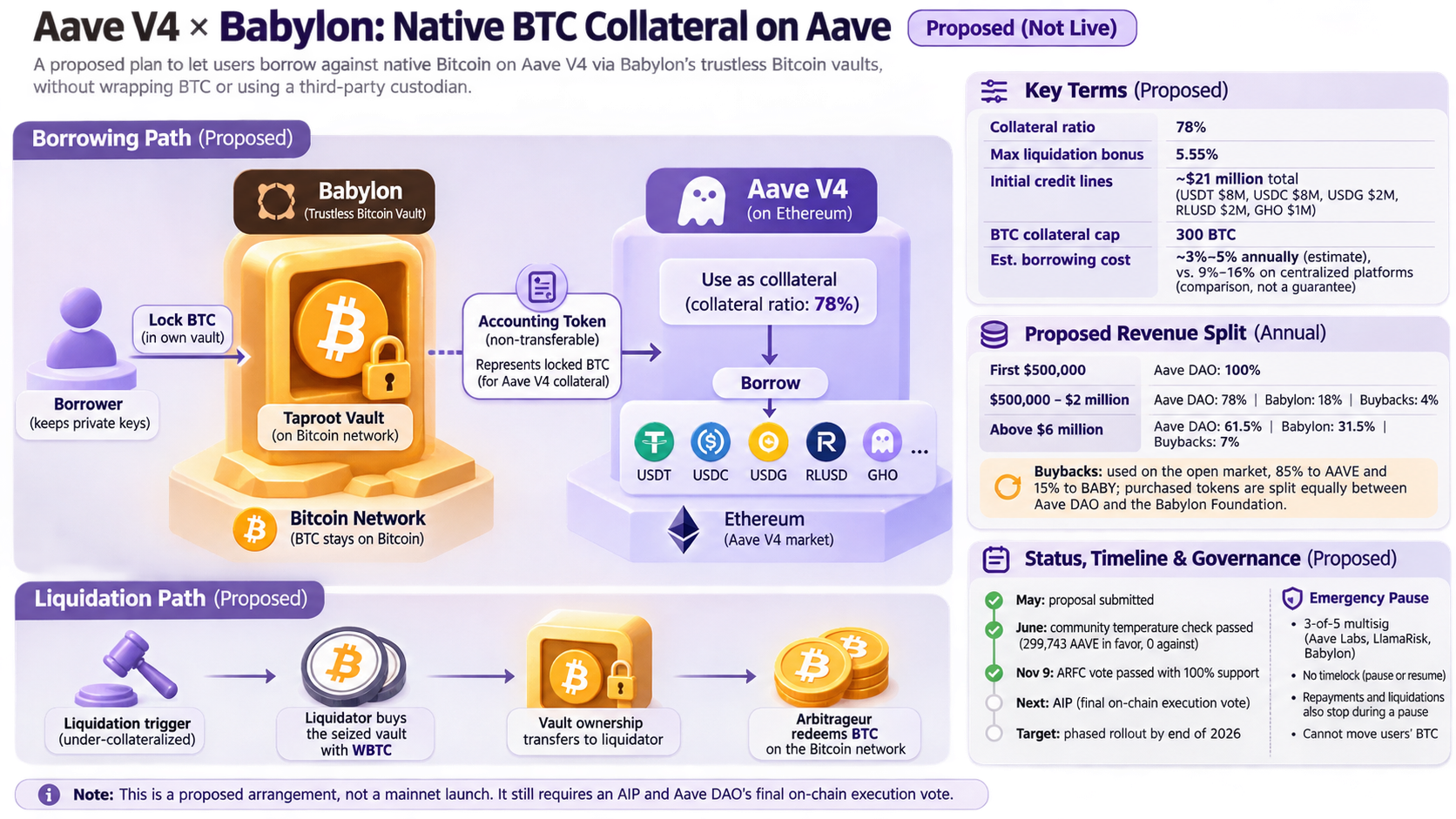
Buyback funds would be used on the open market, with 85% allocated to AAVE and 15% to BABY; the purchased tokens would be divided equally between Aave DAO and the Babylon Foundation. In Alea Research’s illustrative $10 million annual revenue scenario, Aave DAO would receive about $6.92 million, Babylon about $2.52 million, and buybacks about $560,000—including roughly $84,000 for BABY. That is a scenario, not reported revenue.
Scale remains an open question. The original report noted that Aave’s annual AAVE buyback budget had been reduced from $50 million to $30 million under a governance proposal passed in March. Alea Research also estimated roughly 1.58 million new BABY tokens per day, worth about $7 million annually at third-quarter prices. Those comparisons limit what the proposed buybacks alone can establish about either token.
The proposal would give a three-of-five multisignature group including Aave Labs, LlamaRisk and Babylon emergency pause authority, without a timelock for pausing or resuming. Repayments and liquidations would also stop during a pause, although the multisignature group could not move users’ BTC. Alea Research said Babylon planned to submit BABY token-economics changes to governance by the end of November. It also noted that roughly 2,999 BTC staked under Gate’s custody was due to mature around November 30; Babylon’s staking total could change if that stake was not renewed. Neither development was settled as of the November 10 report.