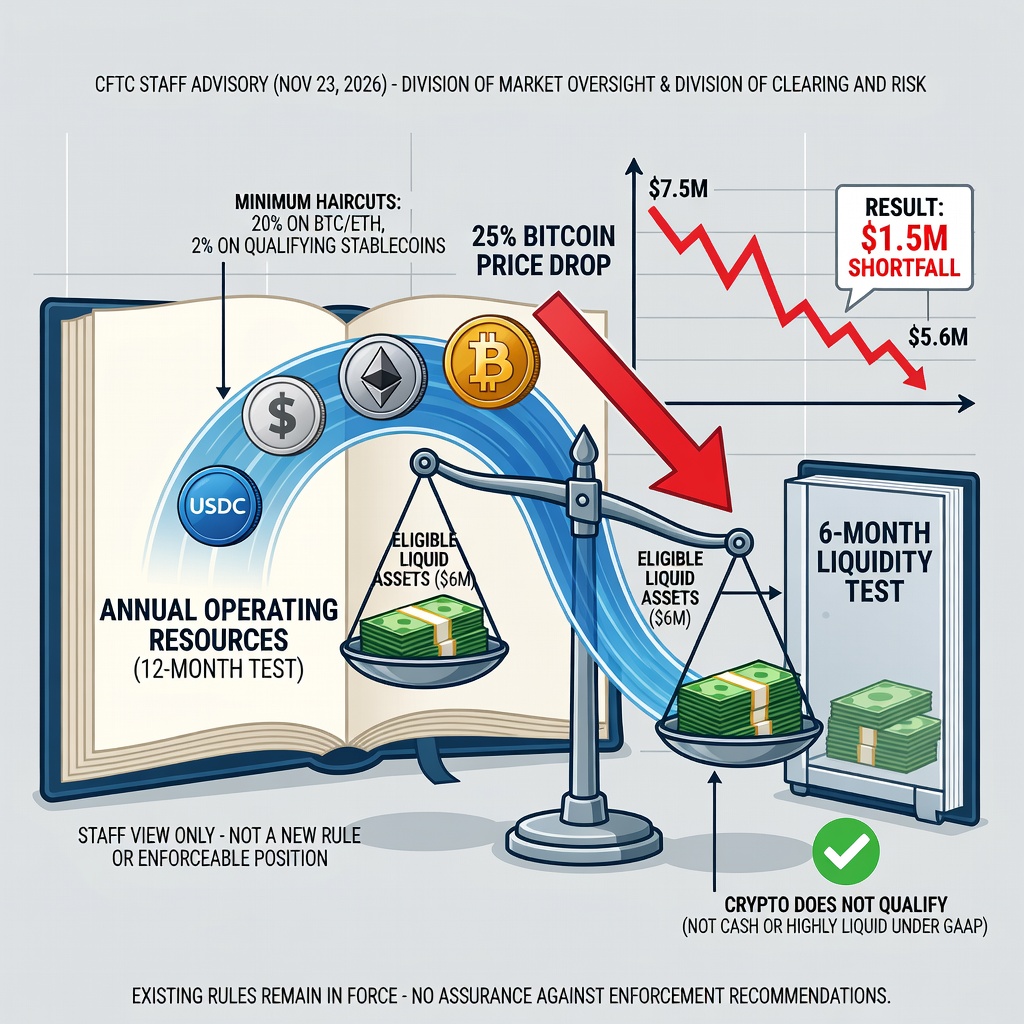
On November 23, 2026, staff at the US Commodity Futures Trading Commission said futures exchanges and clearinghouses may count Bitcoin, Ethereum and qualifying payment stablecoins toward the resources they need to cover a year of operating costs. The same assets cannot satisfy the six-month liquidity requirement, even at a discount.
The advisory came from the Division of Market Oversight and the Division of Clearing and Risk. It addresses swap execution facilities, designated contract markets and derivatives clearing organizations. It states a staff view, not a new rule or necessarily the Commission’s position. Existing rules remain in force. The advisory creates no enforceable rights and is not a no-action position: staff gave no assurance they would decline to recommend enforcement.
How the two tests work
Firms must hold enough financial resources to cover at least 12 months of projected operating costs on a rolling basis. For that test, staff specified a minimum haircut of 20% on the current market value of Bitcoin and Ethereum, and 2% on qualifying payment stablecoins. At the minimum haircut, $1 of Bitcoin counts as 80 cents toward the annual target. If its market price falls, so does the amount the firm can count.
Within that annual pool, firms need enough unencumbered cash or highly liquid securities to cover at least six months of expenses. Crypto does not qualify as either under generally accepted accounting principles. Existing rules separately allow committed credit lines or similar facilities to fill a liquidity gap under certain conditions.
How a Bitcoin decline could leave a $1.5 million shortfall
In a hypothetical example published by CryptoSlate, an exchange projects $12 million in annual costs. It holds $6 million in eligible liquid assets and $7.5 million in Bitcoin. After a 20% haircut, the Bitcoin counts for $6 million. The exchange meets both requirements exactly.
If Bitcoin falls 25%, the position is worth about $5.6 million, of which $4.5 million counts. The exchange now has $10.5 million in eligible annual resources, $1.5 million short of its target. Yet it still meets the six-month test: its $6 million in liquid assets has not changed.
The shortfall was illustrative, not a reported exchange loss. For market context, on November 25 Bitcoin traded near $58,881, down about 27% over 30 days. Ethereum traded near $1,644 after a 2% daily decline.