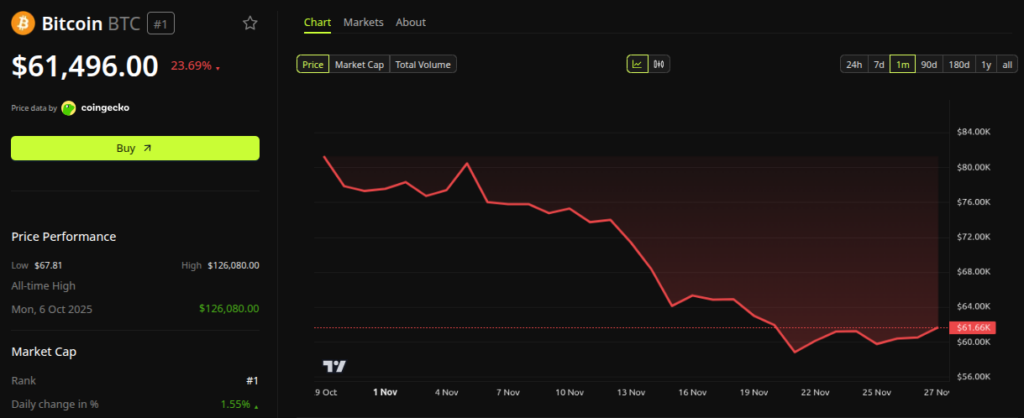
Bitcoin traded near $61,500 on November 27, 2026, down about 30% for the year and more than 50% from its October 2025 record. Gold was near $3,650 an ounce, down roughly 18% for the year, while silver was near $44.20, down about 40%. For Benjamin Cowen, founder of Into The Cryptoverse, the key question is which market turns first.
Cowen said his base case is for Bitcoin to keep falling while gold and silver decline. In 2018 and 2022, the metals reached their lows weeks or months before Bitcoin did. In both comparisons, it was the turn in metals, not the shared decline, that mattered. Cowen would look for strength in gold and silver before looking for it in Bitcoin. The historical sequence gives no precise timetable and does not establish that metals caused either Bitcoin reversal.
The fourth-quarter decline extended beyond crypto
In a November 26 comparison, TedPillows illustrated the breadth of the selloff by showing what a hypothetical $10,000 investment at the start of the fourth quarter would have been worth:
| Asset or index | Value on November 26 |
|---|---|
| S&P 500 | $9,369 |
| Nasdaq | $8,590 |
| Gold | $8,577 |
| Bitcoin | $7,147 |
| Silver | $6,786 |
| Nvidia | $6,467 |
| XRP | $6,356 |
| Ethereum | $6,285 |
| Solana | $5,977 |
Bloomberg Intelligence’s Mike McGlone described the weakness across commodities and crypto as the unwinding of an “everything bubble.” Jared Tate offered a different interpretation of the parallel moves: he argued that derivatives and exchange-traded funds have made Bitcoin behave more like gold and silver.
What the metals signal leaves open
If metals continued to fall, the downside scenarios outlined in the November 27 report included a test of Bitcoin’s realized price, then near $53,000–$54,000, and a possible deeper decline toward its balance price in the high $30,000s. Those were conditional scenarios, not price targets implied by Cowen’s historical comparison.
The recovery case depended on metals stabilizing and Bitcoin subsequently forming a durable low. Under those conditions, the report suggested that Bitcoin’s four-year cycle could support a rally in 2027. In Cowen’s framework, sustained strength in gold and silver would be a reason to watch Bitcoin for a turn, not confirmation that it had already bottomed.