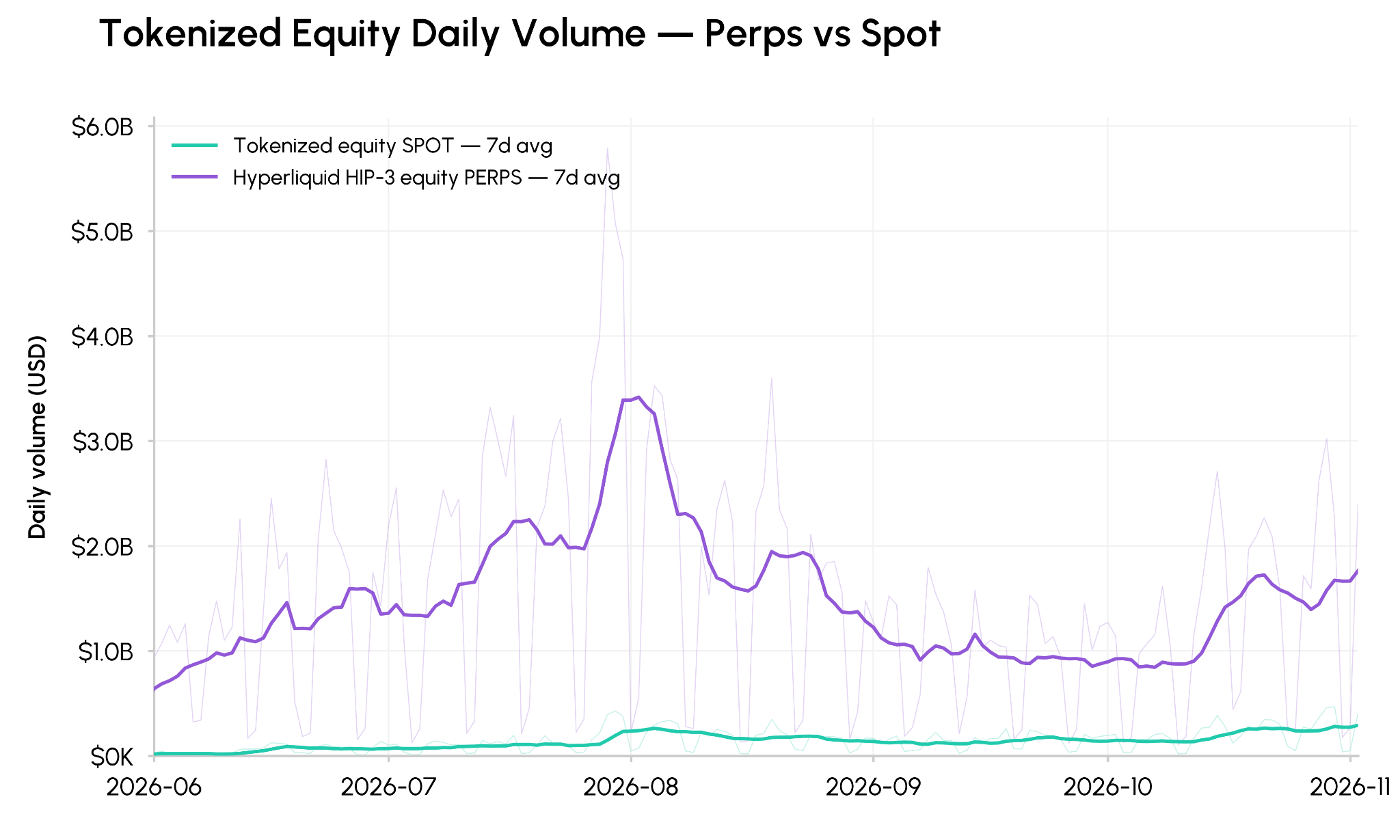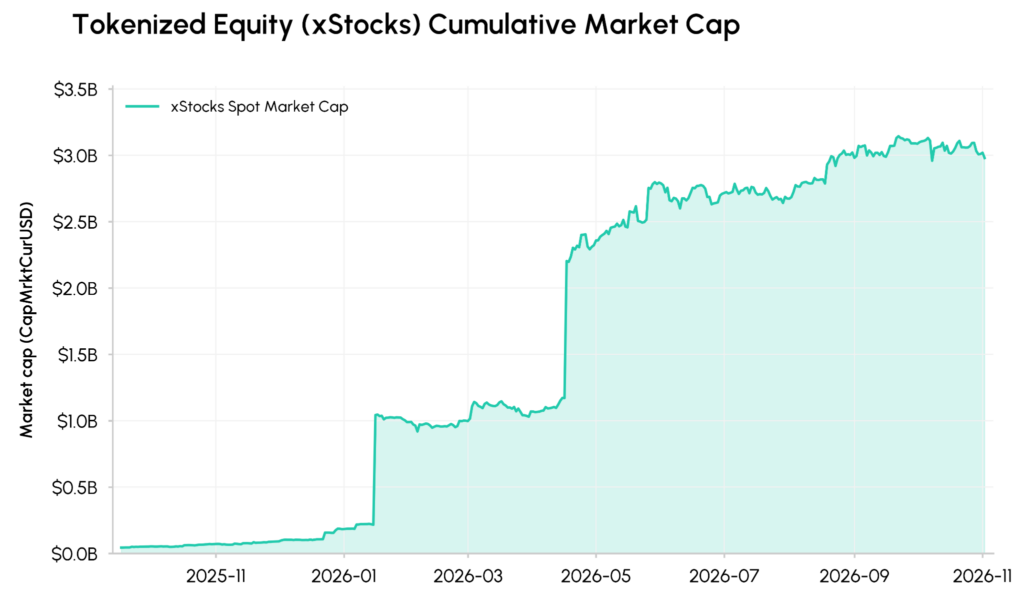
From October 27 to November 2, 2026, tokenized-stock spot markets turned over more than $2 billion, and total spot market value moved above $3 billion as custodians held more underlying shares and issuers minted more tokens. Over that recent week, stock perpetual contracts on Hyperliquid traded about $12.3 billion — roughly six times the $2 billion spot total. Spot capitalization has grown, but spot turnover remains small beside the perpetual market.
The comparison is from Coin Metrics research by Cooper Duschang of Talos, as published by TechFlow on November 10, 2026. The study looks at how tokenized prices sit against the underlying shares, how they behave when US cash markets are shut, and how split the trading venues still are. It does not treat the volume gap as a forecast.
These tokens are generally issued for non-US investors and backed by the underlying stock through licensed custodians. They can quote around the clock, including when traditional markets are closed. Only whitelisted users can mint new tokens or redeem the shares. Holders without that access carry a basis risk if the token trades at a premium or a discount.
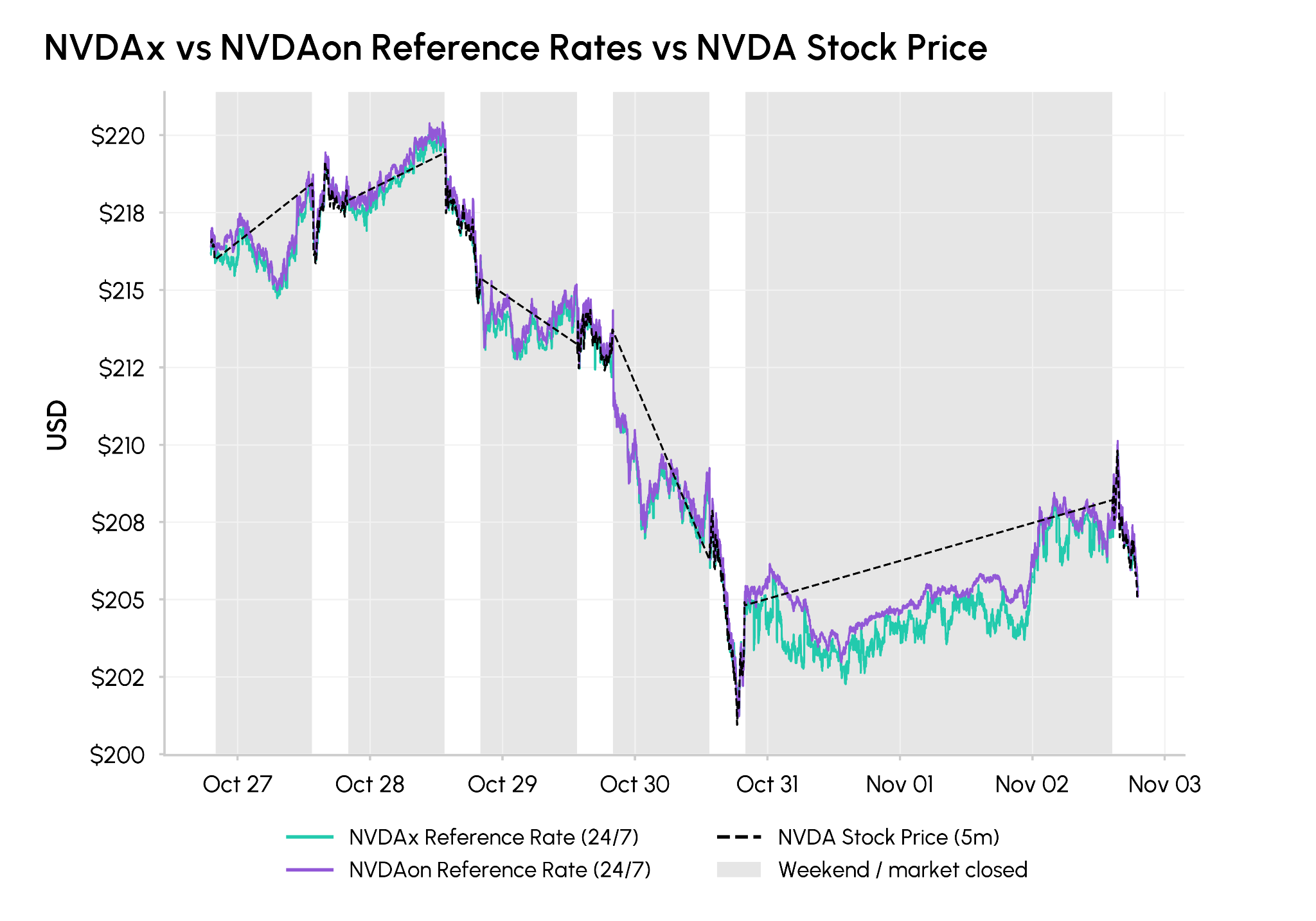
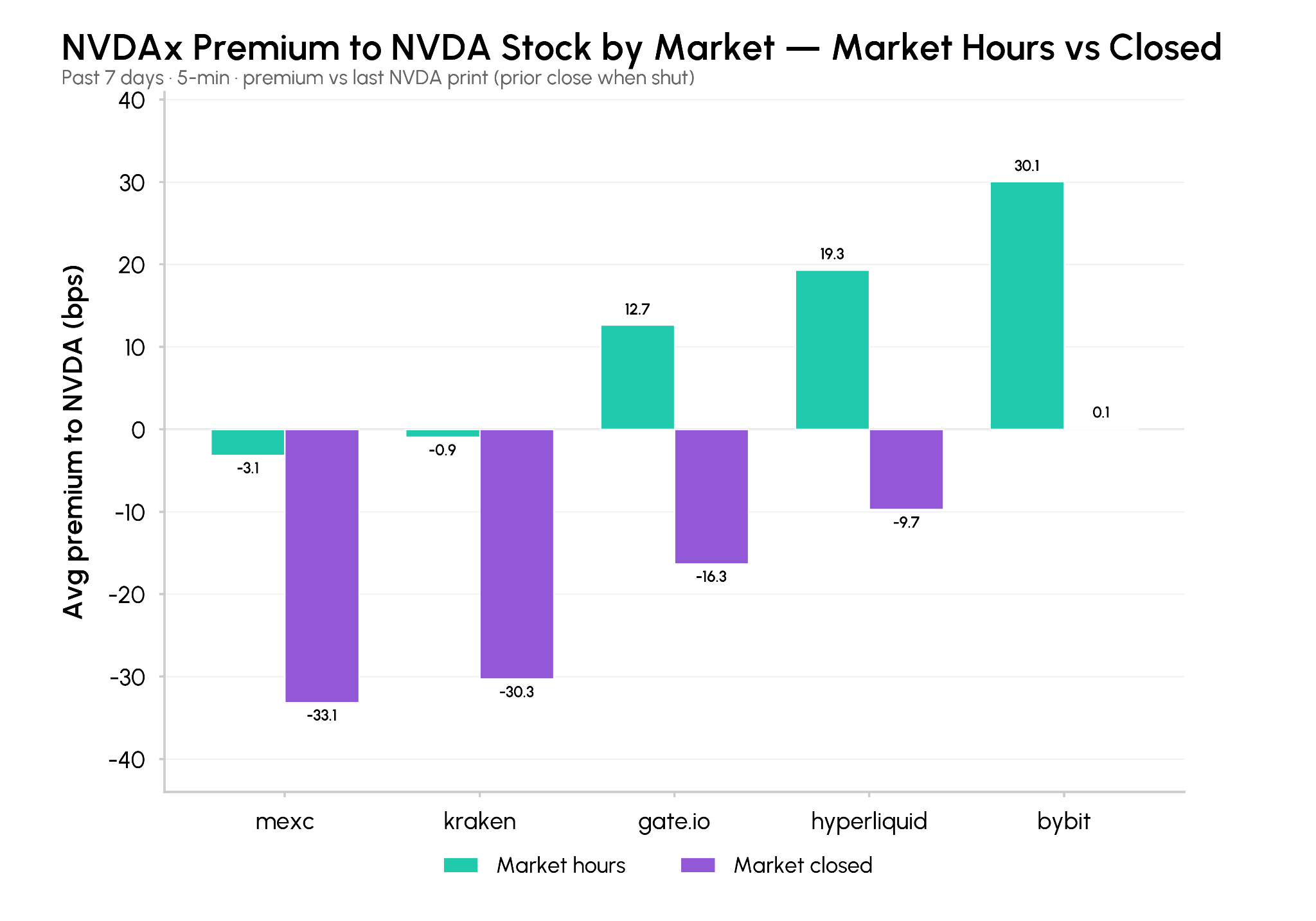
During regular US hours in the October 27–November 2 window, xStocks’ NVDAx traded above NVDA 58.6% of the time, at an average premium of 3.1 basis points. Ondo’s NVDAon was at a premium 88.9% of the time, averaging 14.1 basis points. In a broader selloff, tokenized NVDA also traded below the prior Friday close. Platform differences cut the other way as well: on Kraken, NVDAx averaged a 0.9 basis point discount to NVDA during cash hours. The same token showed different prices across venues in both open and closed sessions.
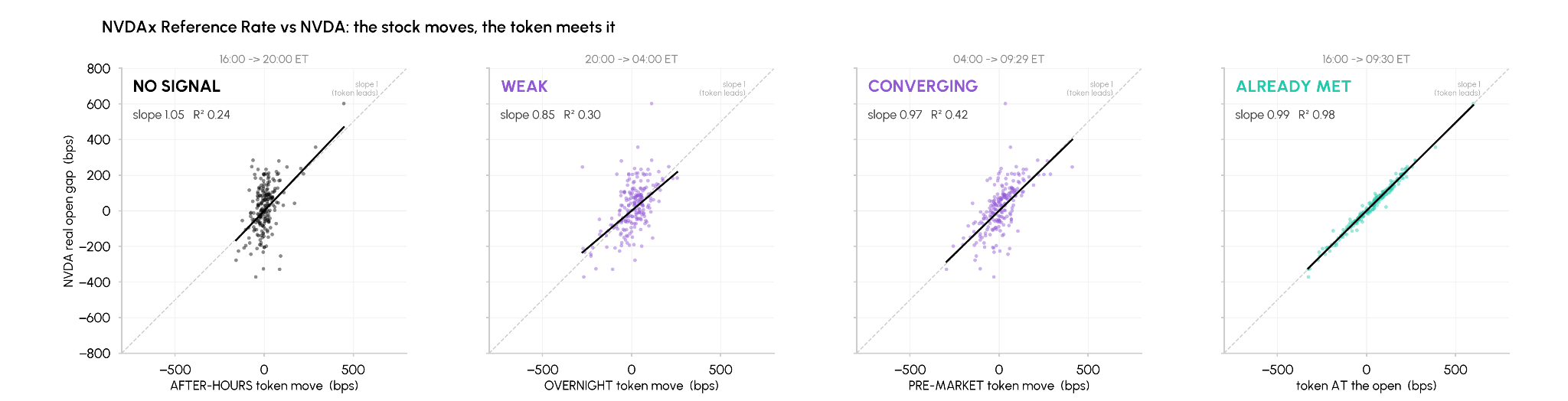
A lead-lag check covering 210 trading days from January 2026 compared NVDAx moves while US stocks were closed with the next session’s NVDA opening gap. Chronology here is not the same as a reliable signal.
- After-hours, 16:00–20:00 ET, the fit was weak: R² of 0.24. Moves just after the cash close carried little information about the next open.
- Overnight, 20:00–04:00 ET, R² was 0.30 — still weak, though slightly stronger, and the link improved closer to the pre-market.
- Pre-market, 04:00–09:29 ET, R² rose to 0.42 as NVDAx moved toward the eventual cash open.
- Across the full closed window, 16:00 ET to 09:30 ET the next day, R² reached 0.98. By the open, the token had largely lined up with the underlying price.
Most of that convergence occurred in the pre-market. After-hours swings alone did not usefully predict the next cash open.
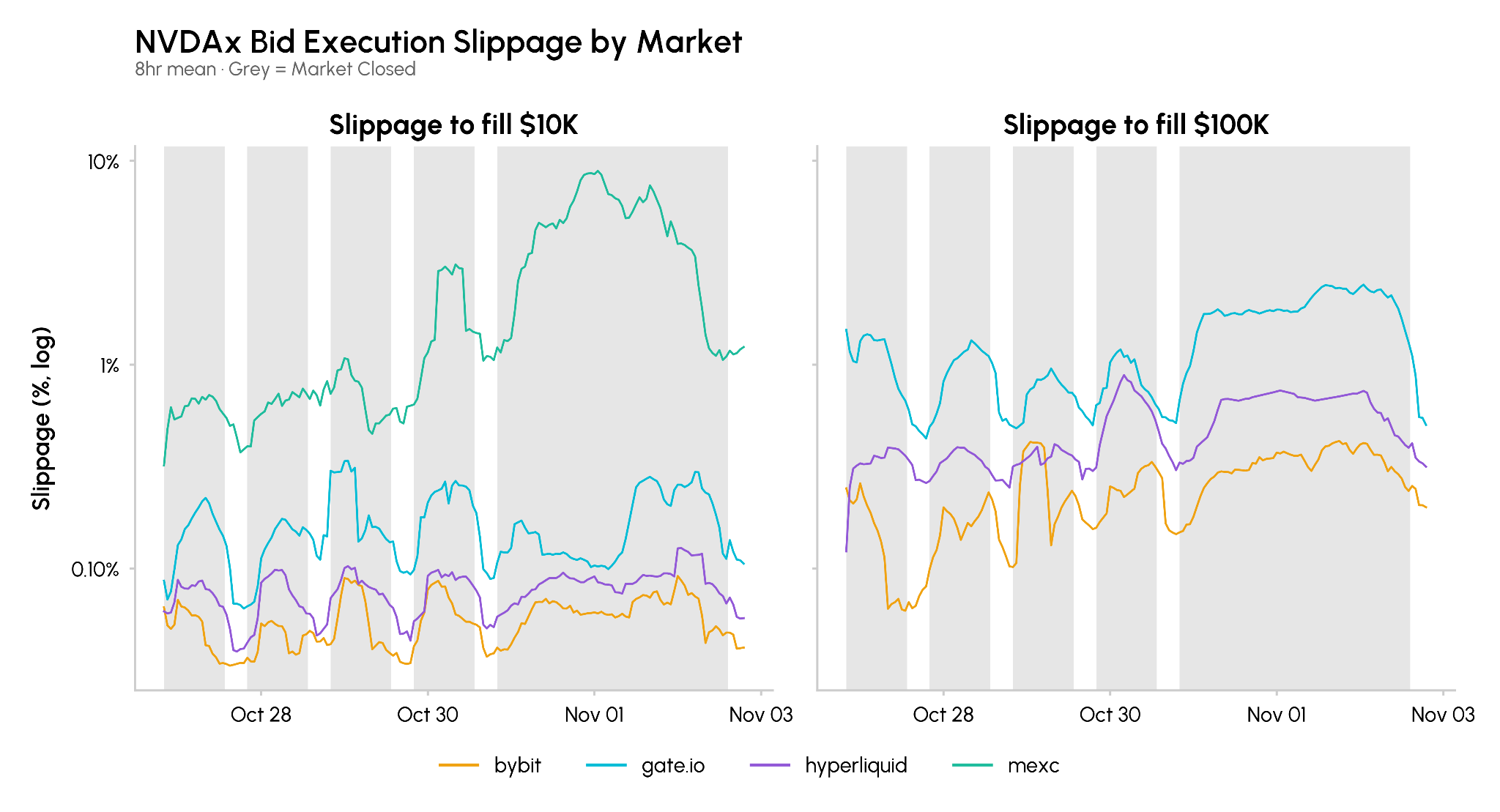
Depth was more fragile once the underlying market shut. Within 1% of the mid-price, NVDAx liquidity on Bybit and MEXC fell by an average of 19%. On Hyperliquid the same 1% depth shrank by about 33%. Orders hitting that thinner book widened price gaps across venues until the cash market reopened. A token that showed the lowest slippage on a $10,000 order at one venue was not necessarily the best place for a $100,000 order.
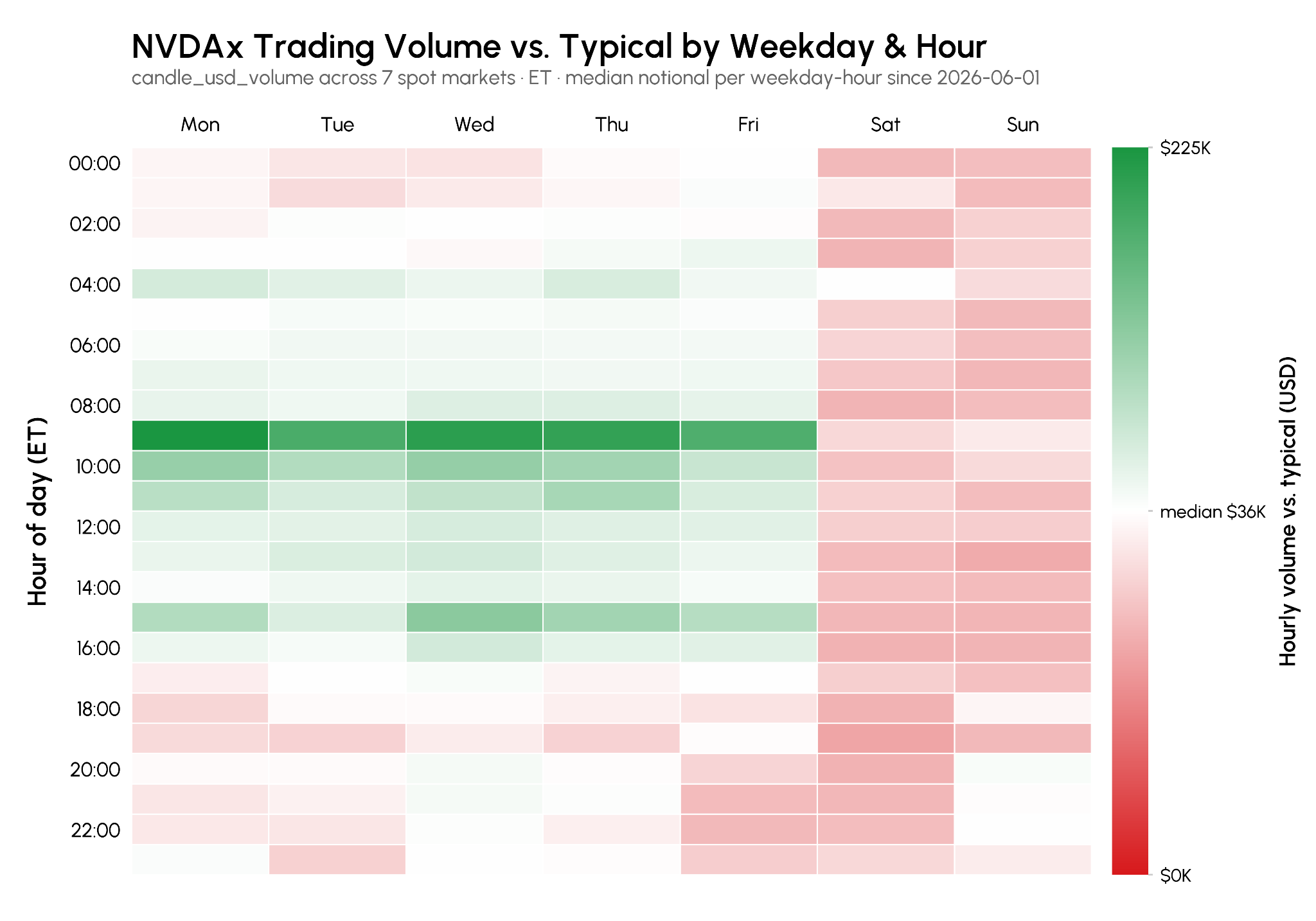
Trading still clustered around the US session. Across seven spot markets, NVDAx hourly turnover had a median of $36,000 and reached $225,000 in the first hour of the cash open. On weekdays from 09:00 to 10:00 ET, average hourly volume was $225,000. Some activity appeared in the pre-market and after-hours around the open and around news. The data do not identify where traders are located, but the offshore venue mix points to international, non-US users whose hours still follow the US cash session.
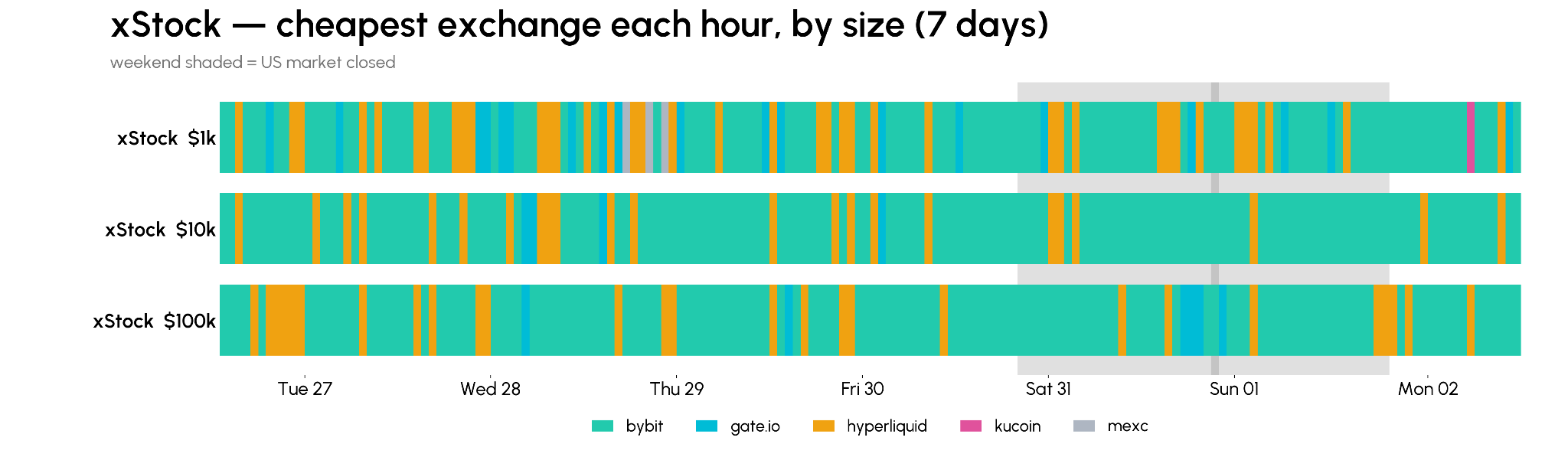
Where an order was sent changed the cost. From October 27 to November 2, Bybit had the lowest slippage on $1,000 orders 58% of the time and Hyperliquid 23% of the time. At $100,000, Bybit or Hyperliquid was the lowest-cost venue 98.2% of the time. Among NVDA token variants, Binance’s NVDAb showed the lowest slippage on $10,000 orders in 96% of observed periods during that window.
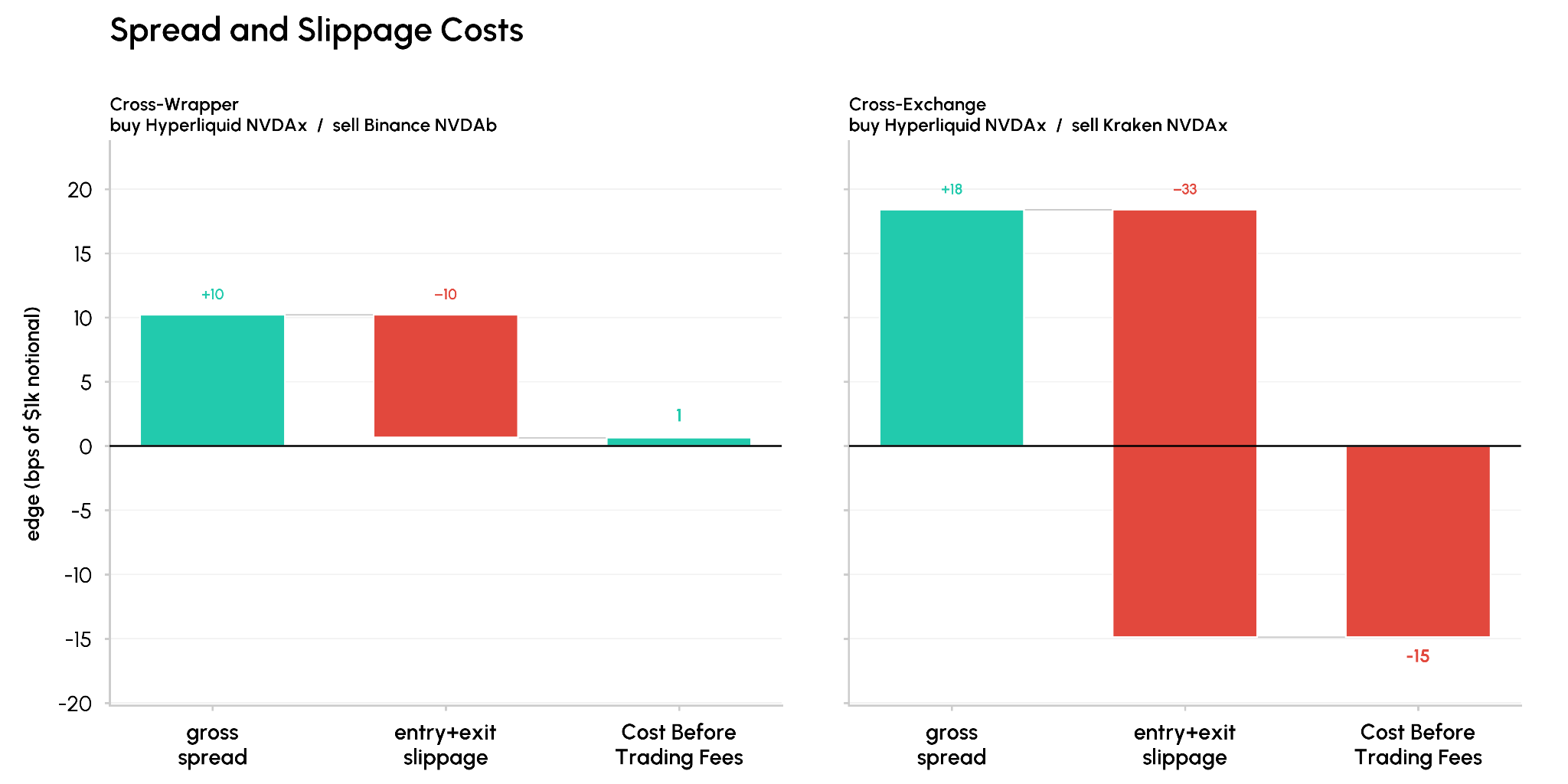
Quoted gaps between venues did not leave a margin after trading costs. From June 2026 through November 2, even on $1,000 orders and before exchange fees, the average bid-ask spread plus round-trip slippage already exceeded the observed cross-venue differences. That held for a long Hyperliquid NVDAx against a short Binance NVDAb, and for a long Hyperliquid NVDAx against a short Kraken NVDAx.
Tokenized stocks give non-US investors a 24-hour on-chain quote on shares that still have a fixed cash session. At the stage described in the study, activity stayed concentrated in traditional US hours, and closed periods brought a clear contraction in depth. Order-book depth, execution slippage, and reference prices are what the research uses to compare cost across token variants and venues.
Original article: TechFlow, November 10, 2026