
Historical reporting note: This article summarizes a Four Pillars weekly report published by 深潮 TechFlow on November 10, 2026, at 12:52 p.m. China Standard Time. The developments below are presented in that reporting context, not as current updates.
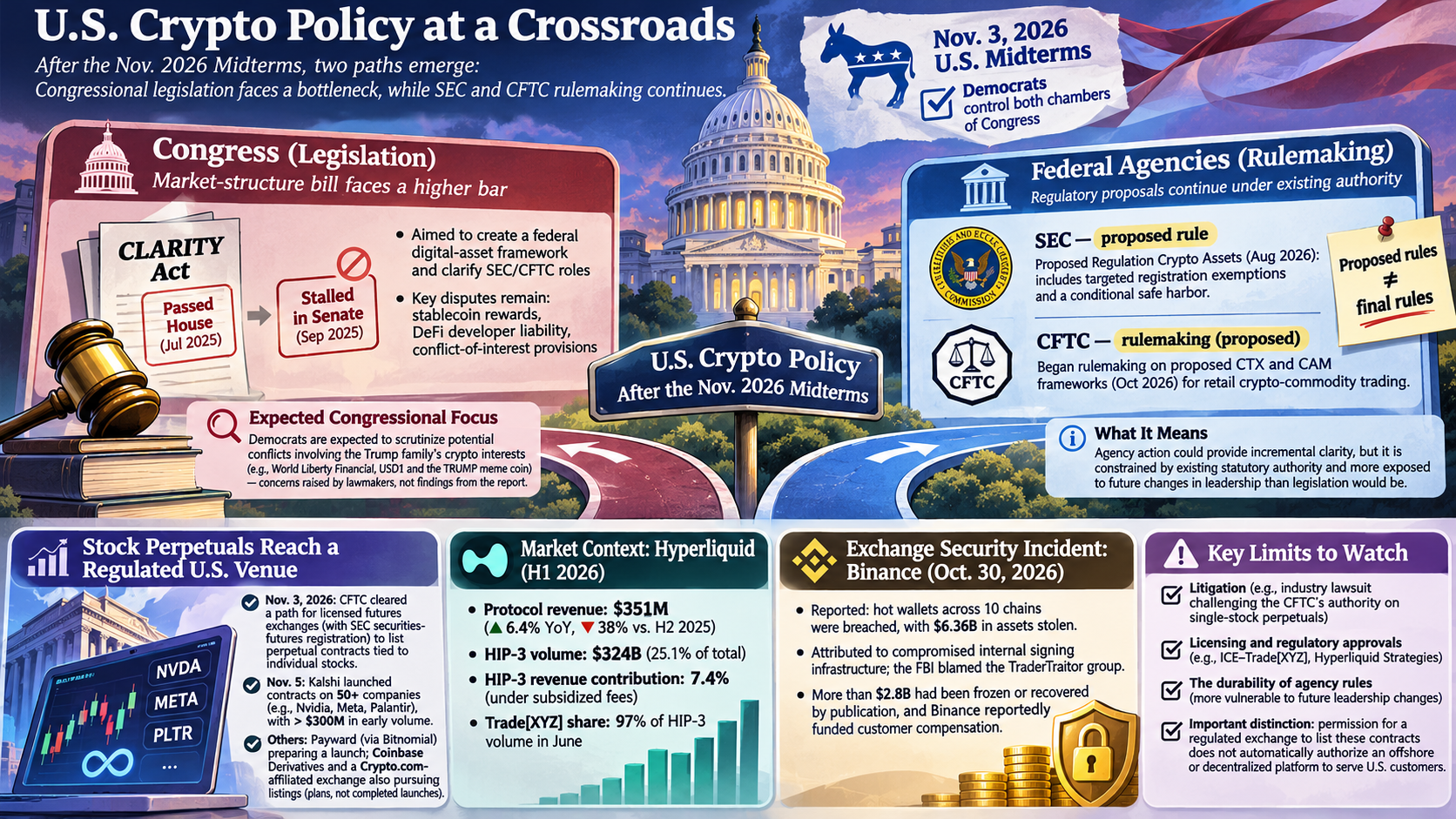
The November 3, 2026, US midterm elections changed the outlook for crypto legislation. According to Four Pillars, Democrats secured control of both chambers of Congress, flipping at least seven Senate seats and gaining more than 20 House seats. The new Congress was due to take office in January 2027. Four Pillars expected the result to make a comprehensive market-structure bill harder to pass—but not to stop work already under way at federal regulators.

Legislation slows; agency proposals continue
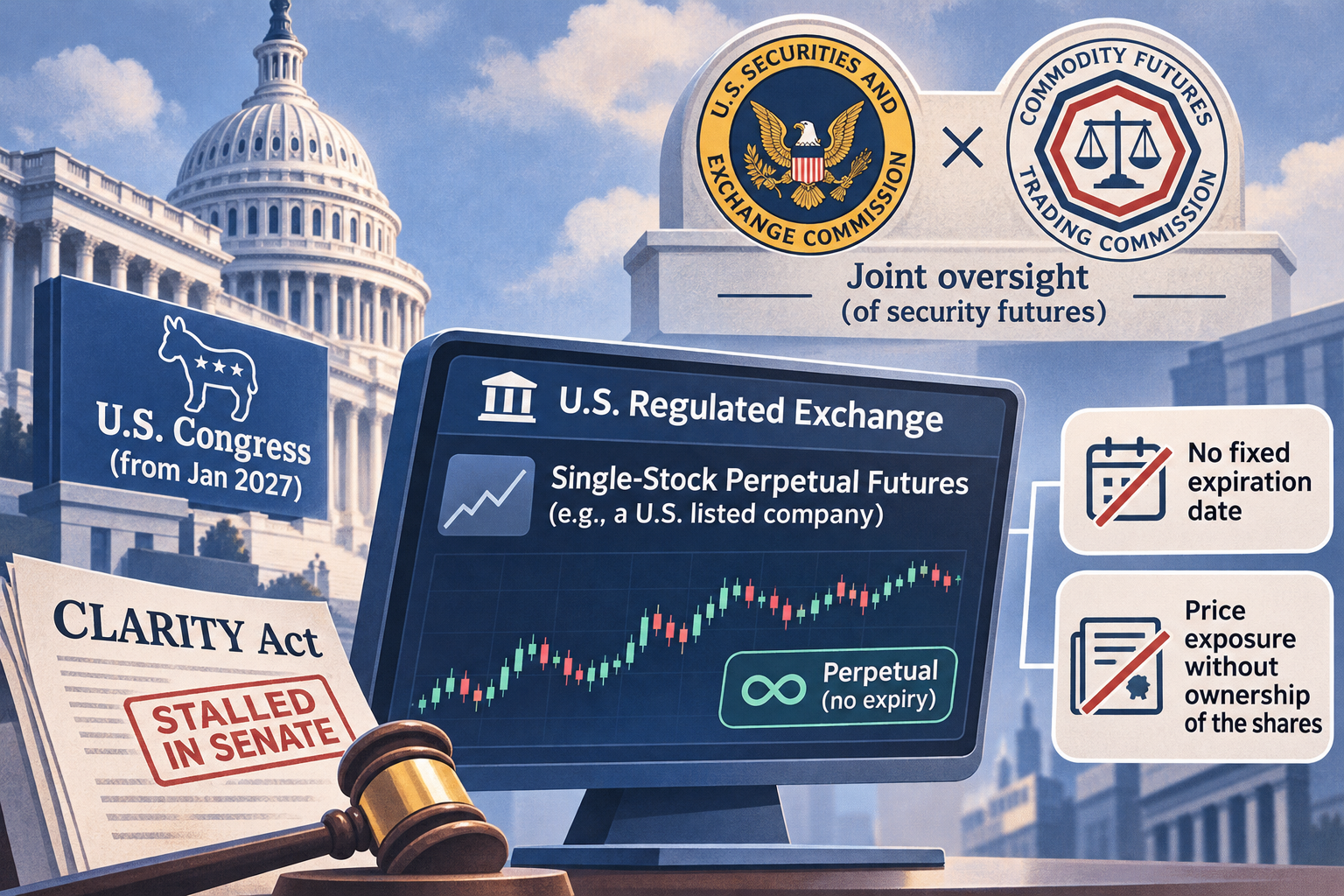
The CLARITY Act, intended to establish a federal digital-asset market framework and clarify the SEC’s and CFTC’s roles, had passed the House in July 2025. Four Pillars said it failed to advance after a 49–50 Senate procedural vote that September. Disputes over stablecoin rewards, DeFi developer liability and conflict-of-interest provisions remained unresolved.

Four Pillars expected the incoming Congress to scrutinize potential conflicts involving the Trump family’s crypto interests, including World Liberty Financial, its USD1 stablecoin and the TRUMP meme coin. These were concerns raised by Democratic lawmakers, not findings established by the report.

The agencies were pursuing a separate path. The SEC had proposed Regulation Crypto Assets in August 2026, including targeted registration exemptions and a conditional safe harbor. In October, the CFTC began rulemaking on its proposed CTX and CAM frameworks for retail crypto-commodity trading. Neither proposal should be mistaken for a final rule. Four Pillars argued that agency action could provide incremental clarity, while noting that it is constrained by existing statutory authority and more exposed to future changes in leadership than legislation would be.
Stock perpetuals reach a regulated US venue
On November 3, the CFTC cleared a path for licensed futures exchanges that also hold SEC securities-futures registration to list perpetual contracts tied to individual stocks, the report said. Such contracts have no fixed expiry and provide price exposure without ownership of the underlying shares. They fall under joint SEC–CFTC oversight as security futures.
Four Pillars reported that Kalshi launched contracts covering more than 50 companies, including Nvidia, Meta and Palantir, on November 5, with more than $300 million in early trading volume. Payward was preparing a launch through Bitnomial, while Coinbase Derivatives and a Crypto.com-affiliated exchange were also pursuing listings. Those plans were not completed launches.
The institutional link to crypto-native infrastructure was still developing. On October 29, Intercontinental Exchange announced an investment and partnership with Trade[XYZ], a platform built on Hyperliquid, with plans for a regulated US venue and clearing infrastructure. Hyperliquid Strategies separately sought futures-commission-merchant registration. Both initiatives still required regulatory approval, according to the report. An industry group including Cboe and Citadel Securities had also sued to challenge the CFTC’s authority to permit single-stock perpetuals under the existing framework.
The distinction matters: permission for a regulated exchange to list these contracts does not automatically authorize an offshore or decentralized perpetuals platform to serve US customers.
The market context—and its limits
Four Pillars’ summary of a Hyperliquid Research Collective report put Hyperliquid’s first-half 2026 protocol revenue at $351 million, up 6.4% year over year but down 38% from the second half of 2025. HIP-3 markets generated $324 billion in volume, or 25.1% of total matched volume, yet contributed 7.4% of protocol revenue under subsidized fee pricing. Trade[XYZ] accounted for 97% of HIP-3 volume in June. Those figures show both the reach of multi-asset perpetual trading and its concentration; they do not establish what regulated US access would earn.
The report also noted a separate exchange-risk episode: it said Binance hot wallets across 10 chains were breached on October 30, with $6.36 billion in assets stolen. It attributed the attack to compromised internal signing infrastructure and said the FBI blamed the TraderTraitor group. Four Pillars reported that more than $2.8 billion had been frozen or recovered by publication. Those claims, and its account of Binance funding customer compensation, are the report’s descriptions of the event—not evidence that other exchanges could absorb a loss of the same size.

The common thread is a widening gap between product development and settled rules. Four Pillars saw potential for agency-led access to advance while Congress remained divided, but flagged litigation, licensing requirements and the durability of agency rules as limits on that path.
Source: techflowpost.com (originally published 2026-11-10 12:52 UTC+8)