Originally reported November 5, 2026, at 04:08 (+08:00). The market figures below describe Wednesday, November 4, not current prices.
Bitcoin recovered its post-Binance-hack losses and traded at $80,500 on Wednesday afternoon, up 3.5% and nearing $81,000. The move followed Tuesday’s U.S. midterm elections, in which Democrats regained control of both chambers of Congress. The sequence does not establish that the election result caused Bitcoin’s rebound.
Nexo analysts said markets took the result “in stride”: futures fell as much as 2.5% during early counts, then recovered fully. They interpreted that reversal as investors gaining clarity rather than changing their view of the growth outlook.
Activity rose faster than open positions
Nexo said crypto futures volume climbed 27% while open interest rose just 3%. Bitcoin open interest also grew more slowly than its price. In Nexo’s assessment, that pattern suggested traders were adjusting existing positions rather than broadly adding leverage. About $469 million in leveraged positions were liquidated. Nexo also reported a slight net buying bias in market orders after sellers had dominated the previous day, while the most actively traded Bitcoin options were predominantly calls.
Ethereum rose nearly 6% to $2,433; Solana and XRP gained about 2.5% each. Among crypto-related stocks, Strategy and Coinbase rose about 6% apiece, Block Inc. gained 15% following its earnings report, and Strive climbed roughly 12%. Strategy’s variable-rate perpetual preferred stock, STRC, reached $100 for the first time since May. The Official Trump (TRUMP) memecoin, by contrast, fell 17%.
What the hack comparison can—and cannot—show
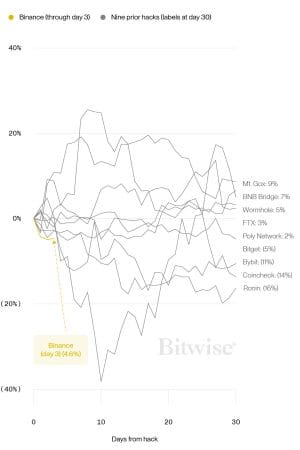
Bitwise CIO Matt Hougan argued that the muted Bitcoin reaction to the Binance breach reflected a more mature industry and improved custody options. Reviewing the 10 largest crypto-related hacks, he found Bitcoin finished higher over the following 30 days in five cases and lower in five. That history offers no consistent post-hack price pattern.
Hougan said Bitcoin’s roughly 4% decline after the breach was broadly in line with other risk assets. He also distinguished the exchange hack from a breach of the Bitcoin network, pointing to institutional custodians, cold storage and spot Bitcoin ETFs as alternative ways to hold exposure.
21Shares crypto research strategist Matt Mena likewise described the market’s response as encouraging, while calling the breach the largest hack in crypto history. Looking into November, he said he was watching whether Bitcoin held $76,000–$78,000 and sustained a move above $80,000–$82,000; Binance’s progress on withdrawals and proof of reserves; credit spreads, oil and long-end Treasury yields; and whether ETF inflows returned. Those were factors to monitor, not a forecast of where Bitcoin would trade next.
Source: theblock.co (originally published 2026-11-05 04:08 UTC+8)