A proposed US Labor Department rule that could make it easier for 401(k) plans to offer crypto reached the White House for final review on November 5, 2026, according to the Office of Information and Regulatory Affairs. As reported on November 7, 2026, it remained a proposal: it did not require retirement plans to offer any cryptocurrency.
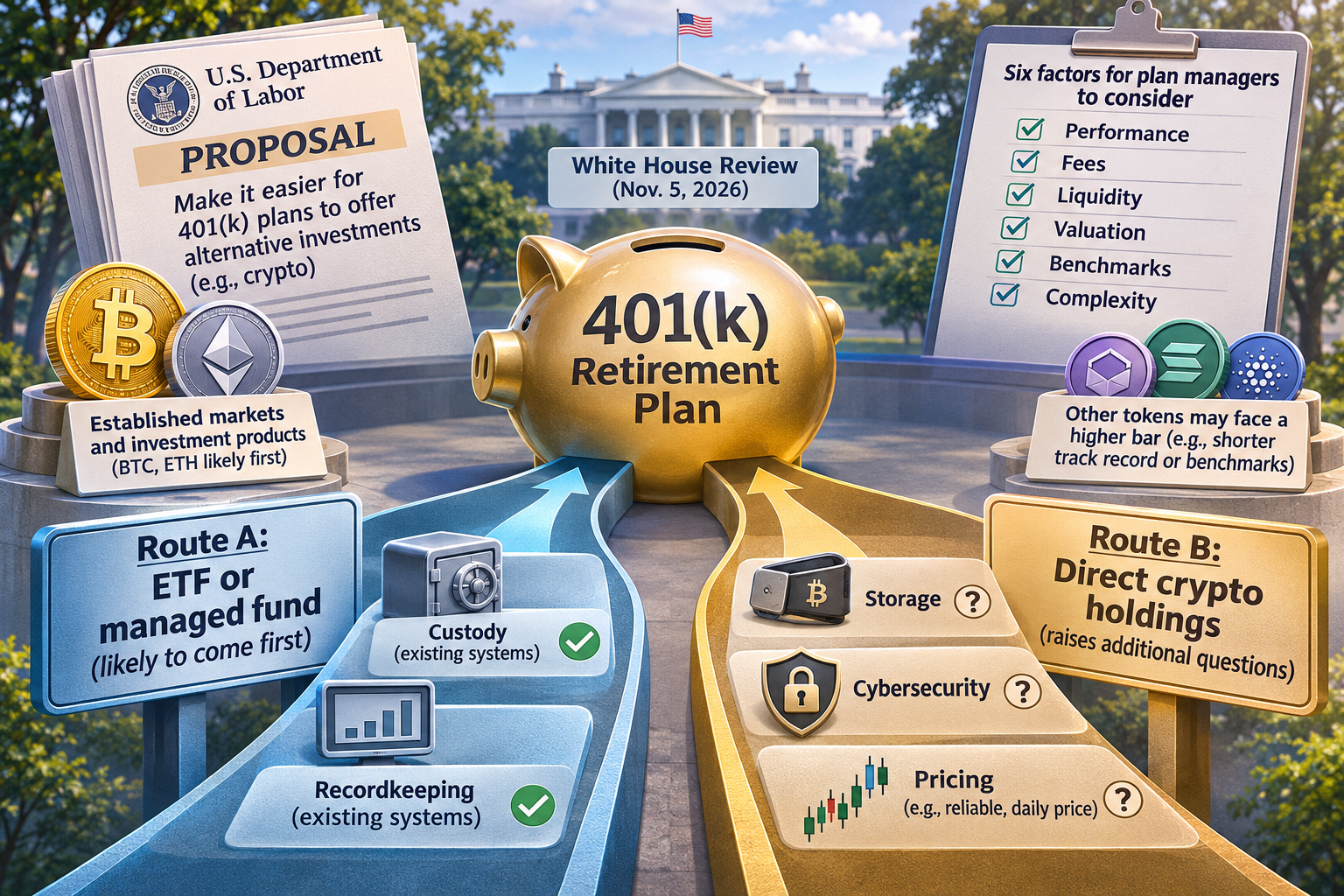
The Labor Department’s March proposal names no eligible digital assets and sets no minimum market capitalization. Instead, it directs plan managers to consider six factors when selecting investments: performance, fees, liquidity, valuation, benchmarks and complexity. The proposal also aims to give employers and plan managers more legal protection when offering alternative investments.

Why smaller tokens face a higher bar
Teresa Goody Guillén, managing partner at Bellementis PLLC, said Bitcoin and Ether would likely come first because they have established markets and investment products. According to CoinGecko data cited in the original report, their market capitalizations were approximately $1.5 trillion and $273 billion, respectively, at 20:01 UTC on November 6. Guillén stressed that size alone should neither qualify nor disqualify a token; plan managers would still need to justify their choices.
Bernardo Brites, co-founder and CEO of Trace Finance, took a narrower view. He argued that Bitcoin clearly meets the practical tests, Ether also meets them, and other tokens fall short on track record or benchmarks. In his view, a plan committee would need to document a reliable daily price through a regulated investment product.
Funds may precede direct holdings
The proposal does not restrict plans to exchange-traded funds (ETFs) or managed funds. Guillén nevertheless said those products would likely come first because they fit existing custody and recordkeeping systems. Direct holdings, she said, would raise additional storage, cybersecurity and pricing questions, though those concerns should not automatically exclude them.
Brites expected a gradual rollout, beginning with existing brokerage options, then standalone ETFs and funds with small crypto allocations. He forecast some options in 2027 and wider availability by 2028. Those were his expectations, not outcomes guaranteed by the proposal.
Legal uncertainty remains. Brites said the proposed protection would not stop lawsuits over investment decisions, and warned that a future administration could reverse the rule. He cited the reversal of 2022 guidance in 2025 as a reason employers might hesitate to make long-term changes.
Source: cointelegraph.com (originally published 2026-11-07 04:04 UTC+8)