A TechFlow report published on November 10, 2026, at 17:52 CST (UTC+8), credited to RootData and using charts from Principia Research and RootData, looks back at crypto primary-market financing in the third quarter of 2026. The quarter’s price window and the financing tape diverged.
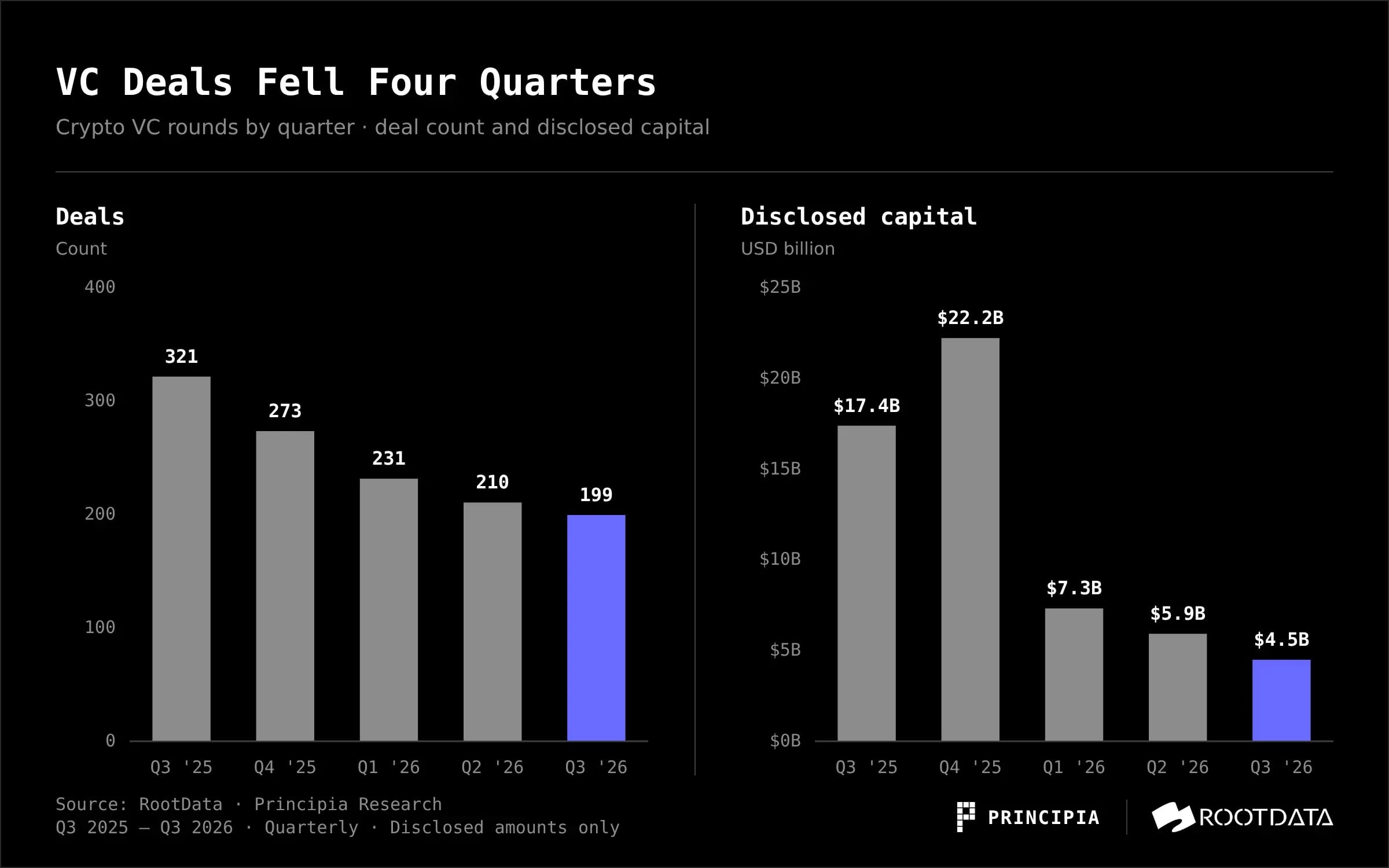
Bitcoin rose from about $58,600 in early July to about $83,600 in early October, roughly 43%. RootData recorded 199 financings in the quarter. Of those, 116 disclosed an amount, totaling $4.46 billion. Deal count was about 5% lower than in the second quarter and had fallen for four consecutive quarters. Disclosed dollars were about 24% lower quarter on quarter and about 74% lower than a year earlier. The report’s point is not that the market stopped. It is that the destination of capital, and the identity of the check-writers, had changed.
The 74% drop is mostly a base effect
The year-earlier comparison is not a like-for-like venture tape. The report says the third quarter of 2025 included large listed-company follow-on sales and an IPO: Strategy at about $2.52 billion, Forward Industries at about $1.65 billion, Galaxy at about $1.4 billion, and the Bullish IPO at about $1.11 billion. After that wave of what the report calls “coin-stock” financing receded, the headline total fell 74% year on year.
The fourth quarter of 2025 is a similar caution, not a matching venture boom. That quarter’s $22.19 billion was also skewed: nearly half came from a single Dunamu acquisition of $10.3 billion.
Strip out a defined set of non-venture items and the direction flips. The report removes listed follow-ons (post-IPO), IPO and de-SPAC deals, mergers and acquisitions, public token sales, OTC transactions, debt financing, and community rounds. From unlabeled rounds it also removes secondary sales, token presales, listed-company financing, and debt of $100 million or more. On that equity-style cut, the third quarter of 2026 was 144 deals and about $3.38 billion disclosed.
That is above the second quarter’s roughly $3.02 billion across 168 deals, and above the third quarter of 2025’s roughly $2.5 billion across 226 deals. Amount was up about 12% quarter on quarter and about 35% year on year. Count was down about 14% quarter on quarter and about 36% year on year. Fewer equity deals, larger ones.
The median disclosed amount rose from $6 million to $8 million. Deals of $100 million or more fell from 17 to 13. The top ten deals’ share of disclosed amount fell from 62% to 57%. The clearest drop was in disclosed deals under $5 million.
Inside the quarter, a few tickets set the monthly path. July was the hot month: $2.37 billion across 72 deals, with Crypto.com, Ionic Digital, and Securitize each at $400 million. August was the cold month: $720 million across 63 deals. September recovered to $1.37 billion across 64 deals, mainly from Polymarket at $300 million and Félix at $200 million.
What the report offers as drivers, and what it does not show
The price rise and the cooler primary market are a chronology. The report does not treat one as the cause of the other. Its authors’ view is that an important reason was AI competing for the same limited LP allocation: compute and model companies were raising large sums, and expectations for their growth were higher, so some capital that might have gone to crypto venture was turning toward AI. That capital shift is not given a dollar figure in the report.
The institutional actions cited as consistent with that view are dated separately from the quarterly totals:
- On July 8, 2026, Paradigm said it had closed a $1.2 billion fourth fund. The mandate widened from crypto to AI, robotics, and other frontier areas, while the firm said it would keep investing in crypto.
- IOSG founding partner Jocy Lin separately set up IOSF Ventures, focused on AI. The report does not date that step or give a fund size.
- On October 22, 2026, after the quarter had ended and before this report, a16z Crypto was renamed a16z Frontier. The new fund’s scope extended to AI, autonomous machines, and other frontier technology, while crypto investing continued.
Some crypto-native investors had also stopped making new bets. In December 2025, after the SEC sued Shima Capital, the founder reportedly said in an internal email to portfolio companies that he was leaving and that the fund would be wound down in an orderly way. In June 2026, Arbitrum DAO’s gaming program AGV proposed making no new investments and only managing the existing book. The proposal passed in early July. About 143.7 million ARB was to be returned to the DAO treasury in batches. In October 2026, Deus X Capital stopped operating, with formal liquidation set for January 31, 2027; CEO Tim Grant became CEO of the AI company TensorX. At the end of that same month, stablecoin-infrastructure specialist Verda Ventures stopped backing new projects after its founder joined Tether, and limited itself to the existing portfolio.
Later rounds and financial pipes took the money
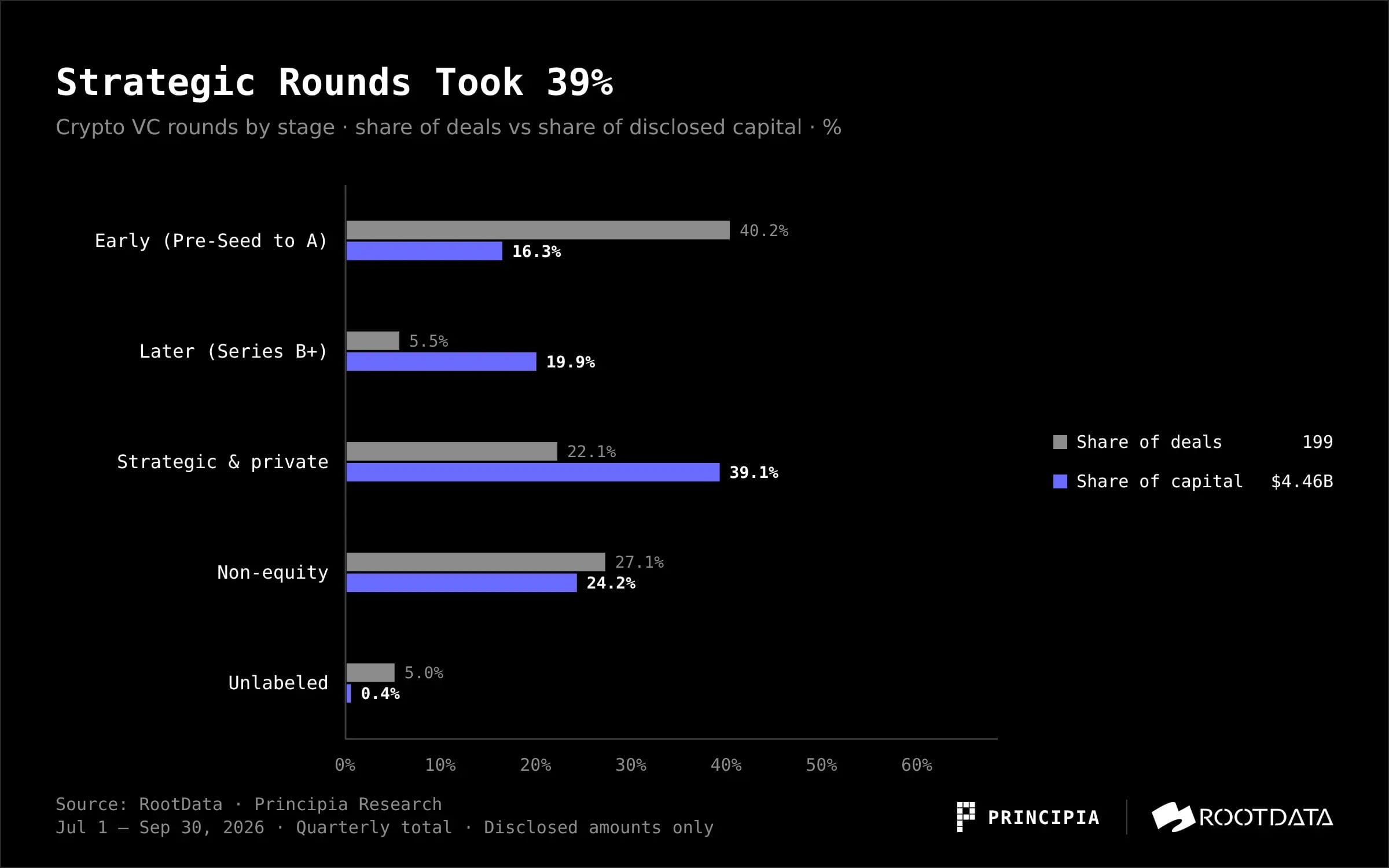
Nearly 40% of the quarter’s capital landed in strategic and private rounds, about $1.75 billion. Early rounds were the busiest by count and a side role by dollars: 80 deals, about 40% of transactions, and only about $730 million, roughly one-sixth of disclosed amount. Deals outside the early rounds took about 84% of disclosed dollars.
The mid-band, $20 million up to but not including $100 million, was 25 deals and about $1.15 billion disclosed, versus 19 deals and about $770 million in the second quarter. Seven of those 25 were OTC, debt, listed follow-ons, or acquisitions. Equity-only, the band was 18 deals and about $870 million: the same count as the second quarter’s 18 deals and about $730 million, with amount up about 19%, and still below the third quarter of 2025 (31 deals, about $1.03 billion). The report treats that as both lower risk appetite and a change in who is writing checks. It also says more quarters would be needed before the mid-band rebound is read as a trend.
Traditional and strategic capital was filling some of the space. Citadel Securities invested $400 million in Crypto.com at a $20 billion valuation. Nasdaq Ventures agreed to invest $100 million in Payward, Kraken’s parent; Bloomberg reported a valuation of about $21 billion. 1789 Capital led a Polymarket round of about $1 billion, contributing about $300 million, at a $21 billion valuation. Tiger Global led Augustus’s $180 million Series B. SBI Holdings led EDX Markets’ $76 million Series C and Gauntlet’s $125 million Series C. The report’s reading is that this money went to licenses, clearing, and trading access rather than to a new narrative.
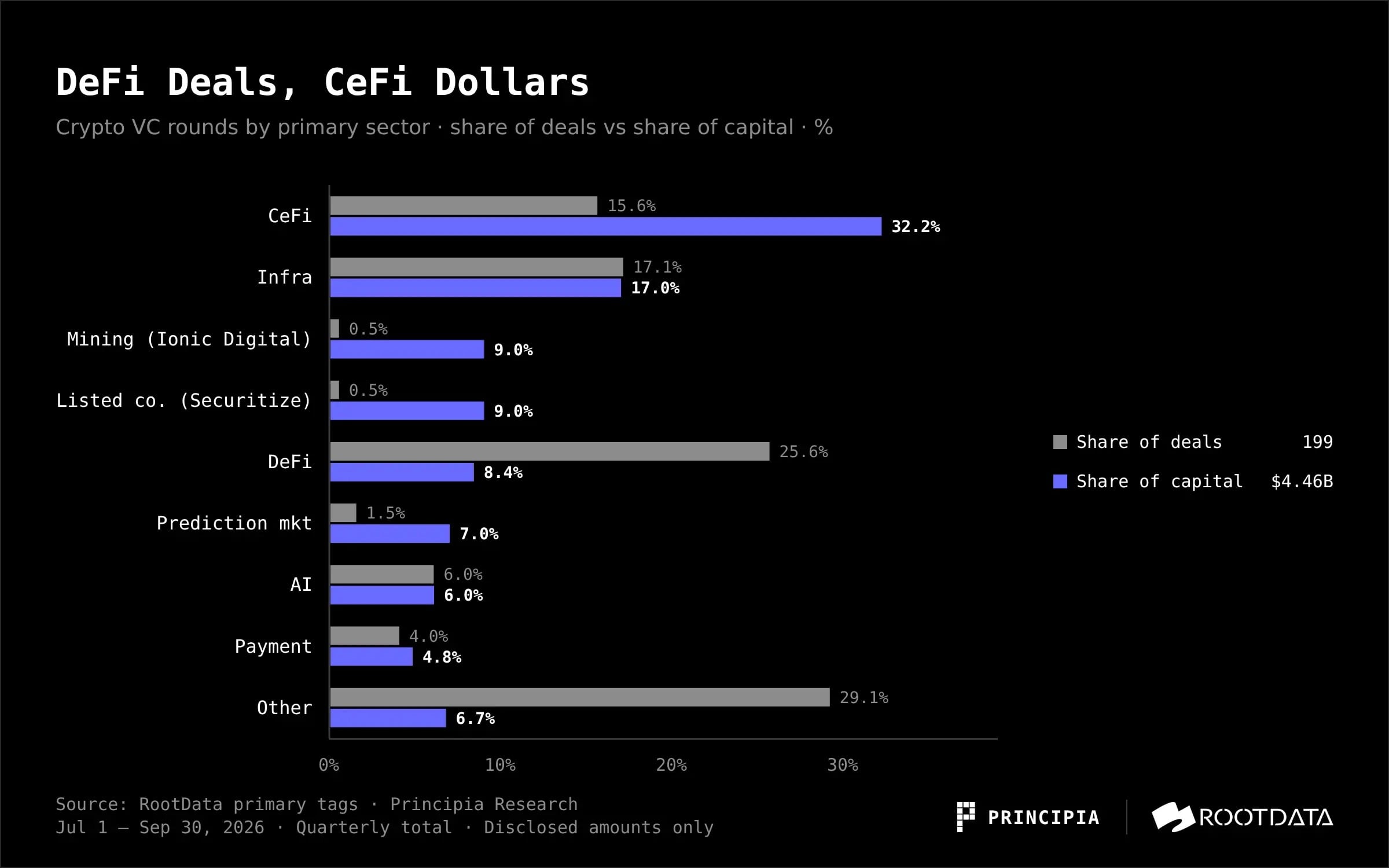
By RootData’s primary tags, CeFi was first by dollars: 31 deals, $1.44 billion, 32% of disclosed amount. The large CeFi names were trading, brokerage, and clearing access: Crypto.com, Kraken, Augustus, Alpaca, and EDX Markets. DeFi had the most deals, 51, and only $370 million, 8%. Infrastructure was second: 34 deals and $760 million, including Ripple via $275 million of senior unsecured notes at Ripple Prime, plus Prime Intellect and Gauntlet. Two further $400 million deals each carried a tag on their own: bitcoin miner Ionic Digital, and Securitize, which listed on the New York Stock Exchange through a SPAC.
DeFi’s low dollar total is partly a disclosure gap. Only 25 of 51 DeFi deals published an amount. Even with that caveat, the report describes DeFi as mostly small, early, and protocol-oriented. Consumer categories were nearly empty. The gaming primary tag was three deals and about $5.9 million.
Crypto-native capital shrank; older companies took the large checks
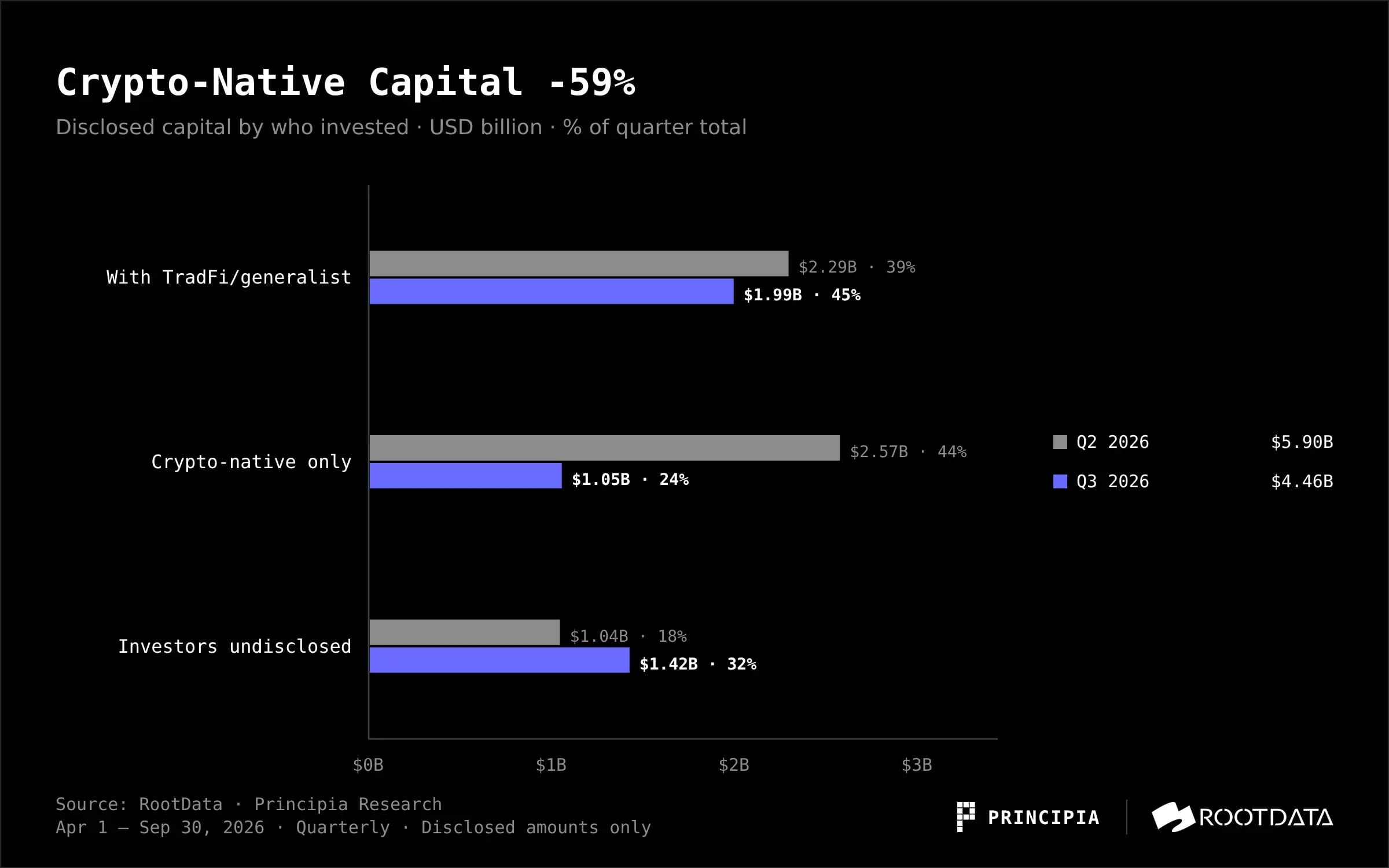
Disclosed amount in deals backed only by crypto-native capital fell from $2.57 billion in the previous quarter to $1.05 billion, a drop of nearly 60%. The share fell from 44% to 24%. The share of disclosed amount in deals that included traditional finance or generalist capital rose from 39% to 45%. The report defines that second group as banks, exchanges and market infrastructure, brokers, asset managers, technology giants, trading firms, and generalist or fintech venture firms. The two shares are reported separately and are not presented as a complete split of the quarter.
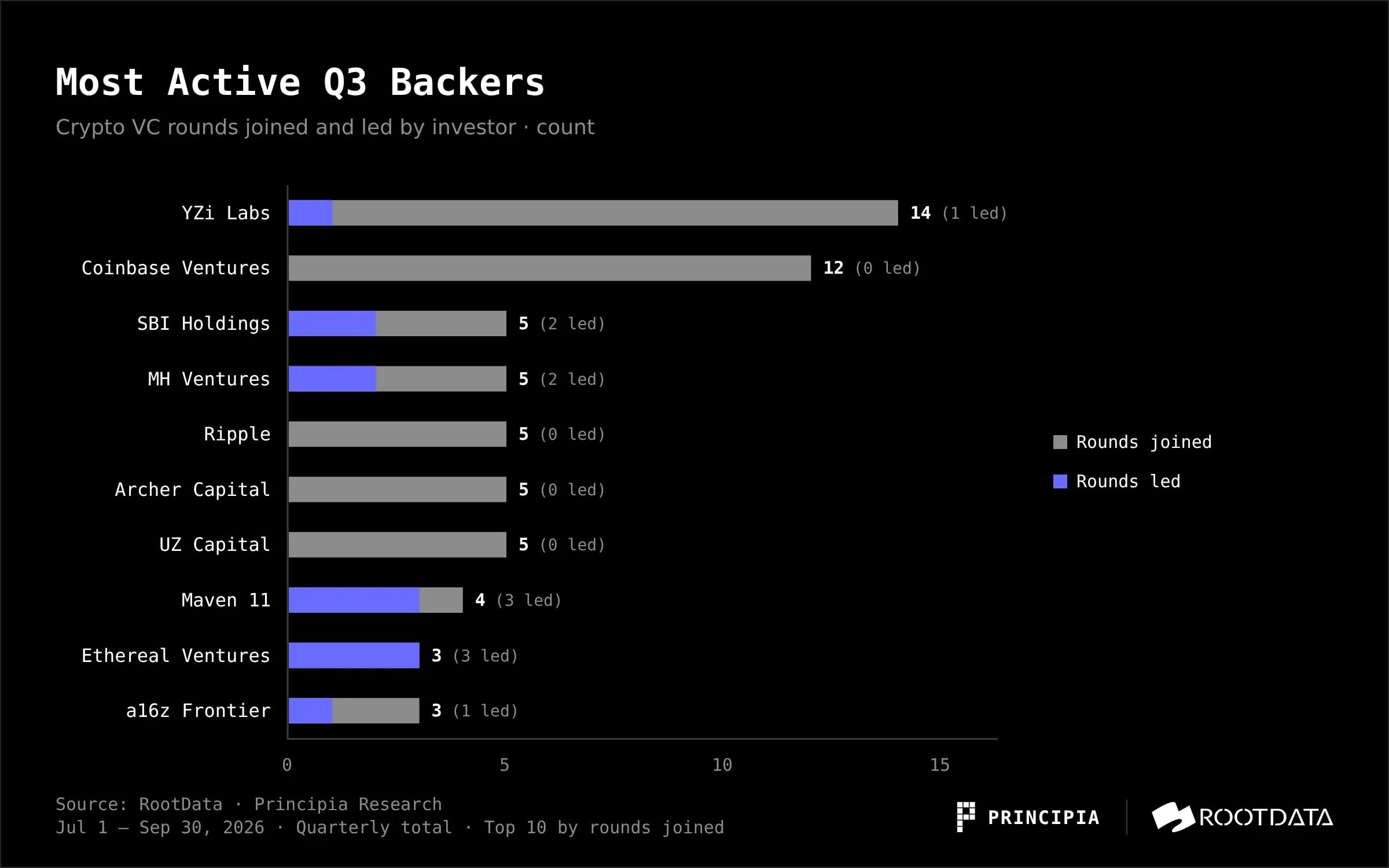
Behind the largest deals, the report names Citadel Securities, Nasdaq, 1789 Capital, Tiger Global, Peak XV, SBI, Intel Capital, and ICONIQ. Counted by appearances, the most active names were YZi Labs and Coinbase Ventures, mostly incubating or following, and rarely leading. In the second quarter the most active names had been Coinbase Ventures (13 times), Animoca Brands (12), and a16z Frontier, formerly a16z Crypto (8). Paradigm had also led four deals that quarter. The report’s judgment is that, this quarter, more of the pricing sat with the traditional institutions above.
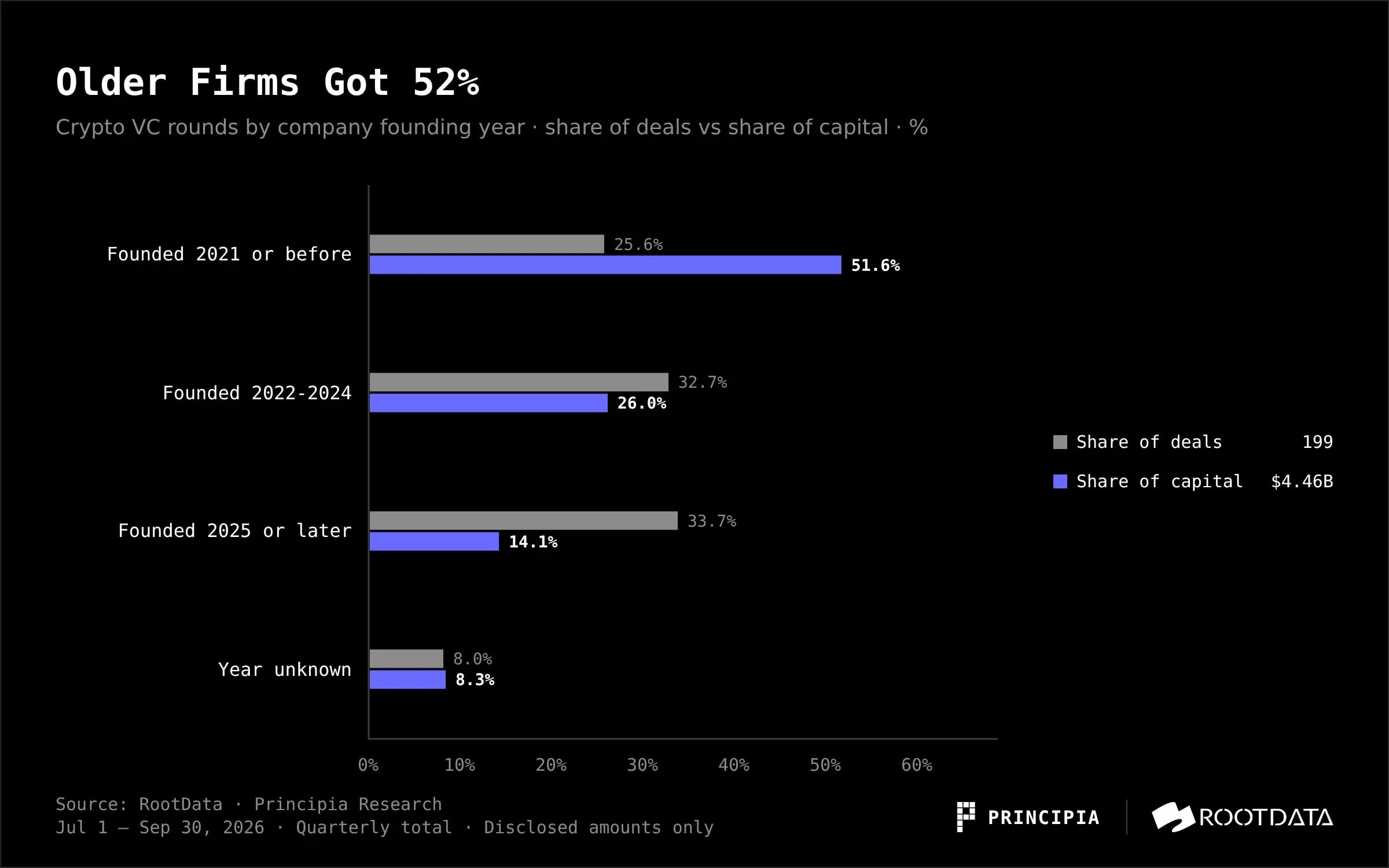
Age cut the other way from deal count. Companies founded in 2021 or earlier accounted for 51 financings and $2.3 billion, more than half of disclosed amount. Companies founded after 2025 had the most financings, 67, and only $630 million. The large checks went to familiar, older firms: Crypto.com (founded 2016), Kraken (2011), Ripple (2013), and Securitize (2017). The report notes that they have revenue, licenses, and businesses that can be valued.
Geography is still a partial sample
RootData’s country field covered 53 of 192 projects, or 28%, corresponding to 55 deals and $2.19 billion, about half of the quarter’s disclosed amount. Inside that sample the report lists the United States at 28 deals and $1.52 billion, and Singapore at 10 deals and $444 million, of which Crypto.com alone was $400 million.
The other countries are described as scattered. The United Kingdom, Bulgaria, and Italy are each put at about $90 million. France is $57 million. Nigeria and South Africa are $40 million each. Hong Kong had three deals and Japan two, both for very small amounts. Coverage is low. The report still reads the partial sample as capital concentrated in the United States, with Asia’s large tickets coming mainly from a Singapore exchange.
New venture funds were scarce
How much the primary market can invest depends on what funds can raise. Citing Galaxy Research, the report says only three new crypto venture funds closed in the quarter, for about $1.3 billion combined, the fewest new funds since the third quarter of 2019.
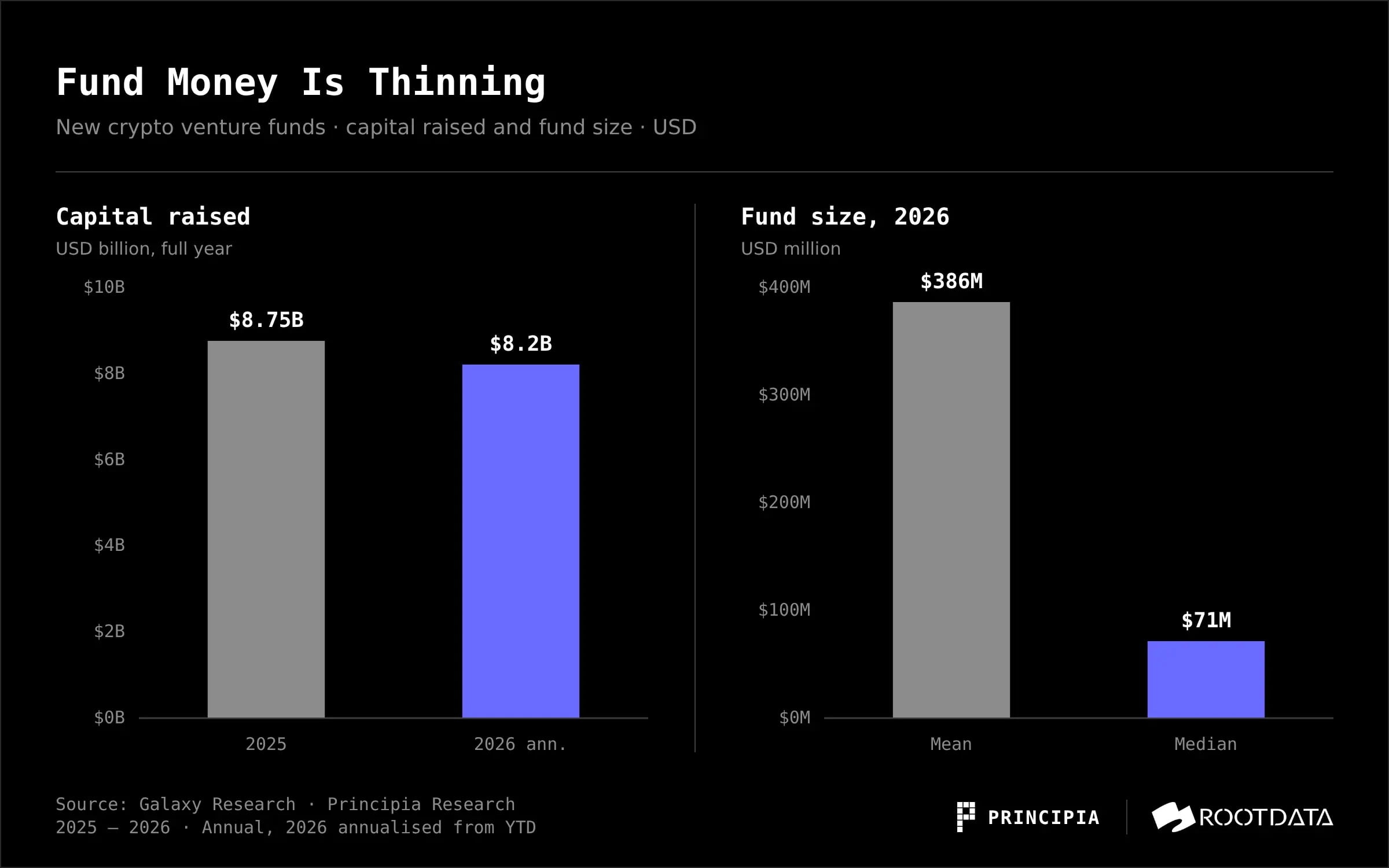
On an annualized basis, 2026 fundraising was about $8.2 billion, slightly below 2025’s $8.75 billion. Year-to-date, the mean new-fund size was about $386 million and the median was $71 million: most new funds were not large, and a few large funds pulled the average up. These fund figures are not part of the $4.46 billion deal total.
The report treats harder fundraising and cooler investing as two sides of one constraint. Spot ETFs, digital-asset treasury companies, and AI were all competing for LP allocation. Its judgment is that tighter LP capital would make GPs more cautious: support follow-on rounds for companies already in the portfolio, and prefer businesses with revenue and licenses. That is the shape it says the quarter already showed.
What the November 2026 report left open
The authors’ summary: venture activity was cooling; money was going to financial pipes that can charge fees, hold licenses, and clear trades; more pricing power was moving to traditional institutions; LP fundraising was cold; and later rounds for startups did not look favorable.
They also separate that reading from a cycle call. Bitcoin’s roughly 43% rise did not automatically pass through to the primary market, so the older pattern of “price up, venture hot” had not held in this quarter. They do not treat the mid-band dollar rebound as confirmed, because the equity-deal count in that band was flat.
As of this November 10, 2026 publication, the report flagged three questions for the fourth quarter, without answering them: whether traditional finance would keep participating after appearing in 45% of disclosed amount, or whether that share was a few large tickets; whether a rebound in the number of small early rounds, not just the bitcoin price, would show a real warming at the startup end; and whether the CLARITY Act would advance and whether new funds would close before year-end.
Those are the report’s open items at the time of publication, not later results.
Original report: TechFlow, November 10, 2026.